ExxonMobil (XOM)
XOM Chart
1D • NYSE
9 Oct, 09:10 am
181.5 KB
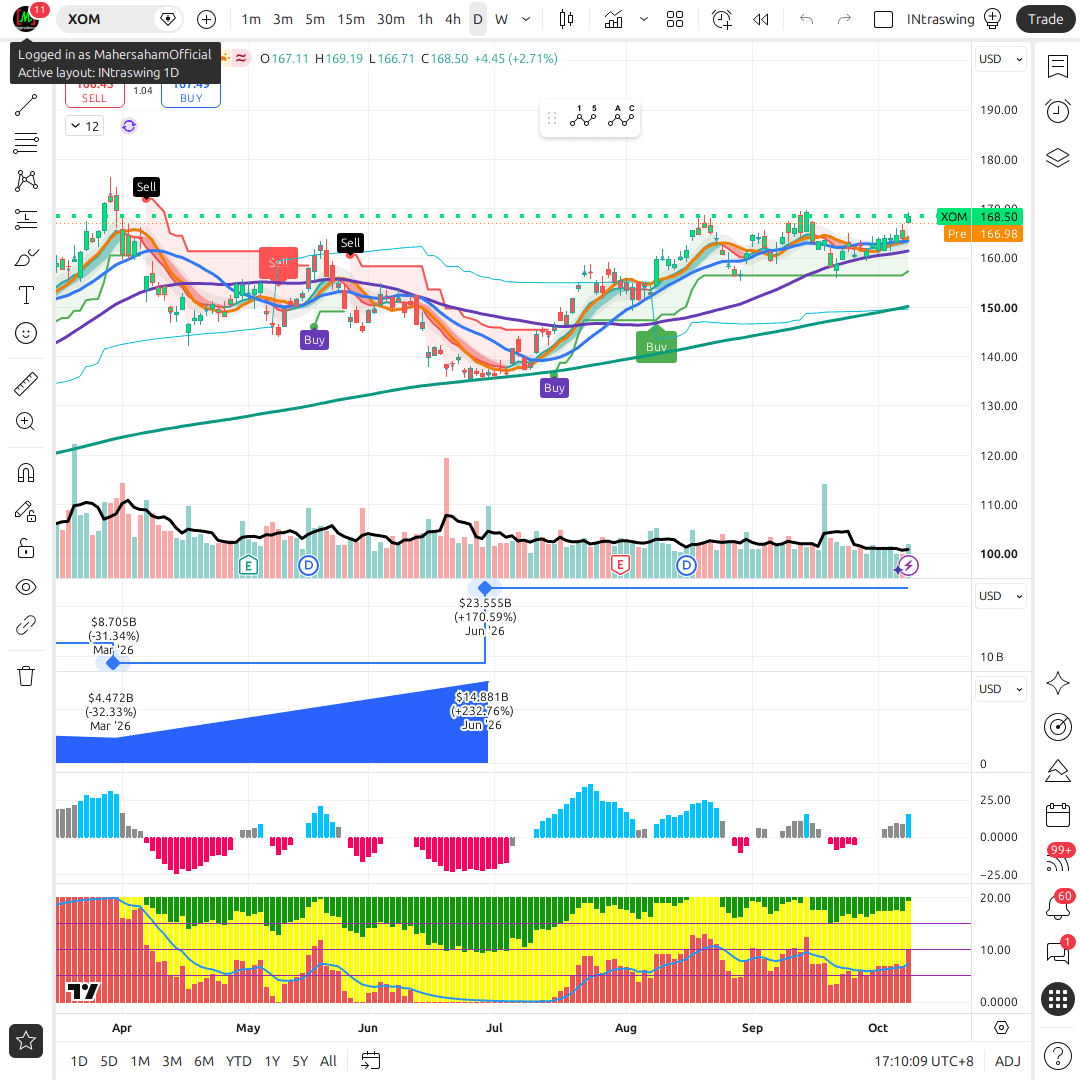
Company Profile — ExxonMobil (XOM)
An Integrated Energy Major, Not Just an Oil Driller
ExxonMobil is one of the world's largest fully integrated energy companies, operating across four segments: Upstream (exploration & production), Energy Products (refining and marketing), Chemical Products (petrochemicals), and Low Carbon Solutions (carbon capture, hydrogen, lithium). This integration means XOM earns across multiple points of the energy value chain rather than depending on a single commodity price.
Major Portfolio Transformation: Pioneer and Denbury
The biggest story shaping XOM since 2024 is a pair of transformative deals. First, the Pioneer Natural Resources merger (closed May 2024, an all-stock transaction worth roughly $59.5 billion) more than doubled Permian Basin production to about 1.3 million barrels of oil equivalent per day, with a target of roughly 2.0 million boe/d by 2027. This is the single largest structural change to XOM's upstream portfolio in over a decade, giving the company more than 1.4 million net acres and an estimated 16 billion barrels of resource across the Delaware and Midland basins.
Second, the Denbury acquisition (roughly $4.9 billion, all-stock) added around 1,300 miles of CO2 pipelines plus Gulf Coast and Rockies sequestration sites — infrastructure that feeds directly into the company's Low Carbon Solutions/CCS strategy.
Brief Factual Note: Texas Redomiciliation (July 2026)
On July 1, 2026, shareholders approved changing the parent company's legal domicile from New Jersey to Texas. The new parent is named ExxonMobil Holdings Corporation, with the former Exxon Mobil Corporation now surviving as a wholly-owned subsidiary. Ticker XOM is unchanged and NYSE trading continues seamlessly — this is purely a legal/governance restructuring (many S&P 500 companies have made similar moves for a more favorable legal environment), not a change in business model, a spin-off, or a distress signal. Investors should not be confused if the new legal name appears on some data platforms.
Leadership
Darren Woods continues as Chairman & CEO, steering a capital-discipline strategy that prioritizes high-margin assets (Permian, Guyana, LNG) over broad low-carbon spending where market demand hasn't yet caught up.
Low Carbon Solutions: A Strategic Recalibration
XOM originally guided $30 billion of lower-carbon capex for 2025-2030. CEO Darren Woods cut this to $20 billion, citing a lack of customers willing to pay a premium for low-carbon products — a demand-side constraint, not a technology or supply-side one. Roughly $10 billion of the freed-up capital was redirected to three core, high-return assets: Permian, Guyana, and LNG.
Shariah Compliance Status
Per the Zoya shariah reference database, XOM is currently classified as Shariah Compliant. Muslim investors are still encouraged to periodically re-check compliance status, since it can shift as the company's financial ratios change over time.
Exclusive Gold Members Content
Get in-depth analysis, target prices, and investment recommendations with Gold Members subscription.
How to Get Gold AccessCANSLIM Analysis
Exclusive Gold Members Content
Get in-depth analysis, target prices, and investment recommendations with Gold Members subscription.
How to Get Gold AccessFinancial Analysis
This section is being refreshed with the latest figures. Please check back soon.
Dividends
This section is being refreshed with the latest figures. Please check back soon.
Valuation: Expensive or Fair?
Exclusive Gold Members Content
Get in-depth analysis, target prices, and investment recommendations with Gold Members subscription.
How to Get Gold AccessPeer Comparison (Integrated Oil & Gas Majors)
Exclusive Gold Members Content
Get in-depth analysis, target prices, and investment recommendations with Gold Members subscription.
How to Get Gold AccessRed Flags & Risks
Exclusive Gold Members Content
Get in-depth analysis, target prices, and investment recommendations with Gold Members subscription.
How to Get Gold AccessScorecard: 8-Criteria Assessment
Exclusive Gold Members Content
Get in-depth analysis, target prices, and investment recommendations with Gold Members subscription.
How to Get Gold AccessCatalysts: Positive & Negative
Exclusive Gold Members Content
Get in-depth analysis, target prices, and investment recommendations with Gold Members subscription.
How to Get Gold AccessConclusion: The Core Question & Investor Profile
Exclusive Gold Members Content
Get in-depth analysis, target prices, and investment recommendations with Gold Members subscription.
How to Get Gold AccessRelated Stocks
Other stocks in the Energy sector