The Kroger Co. (KR)
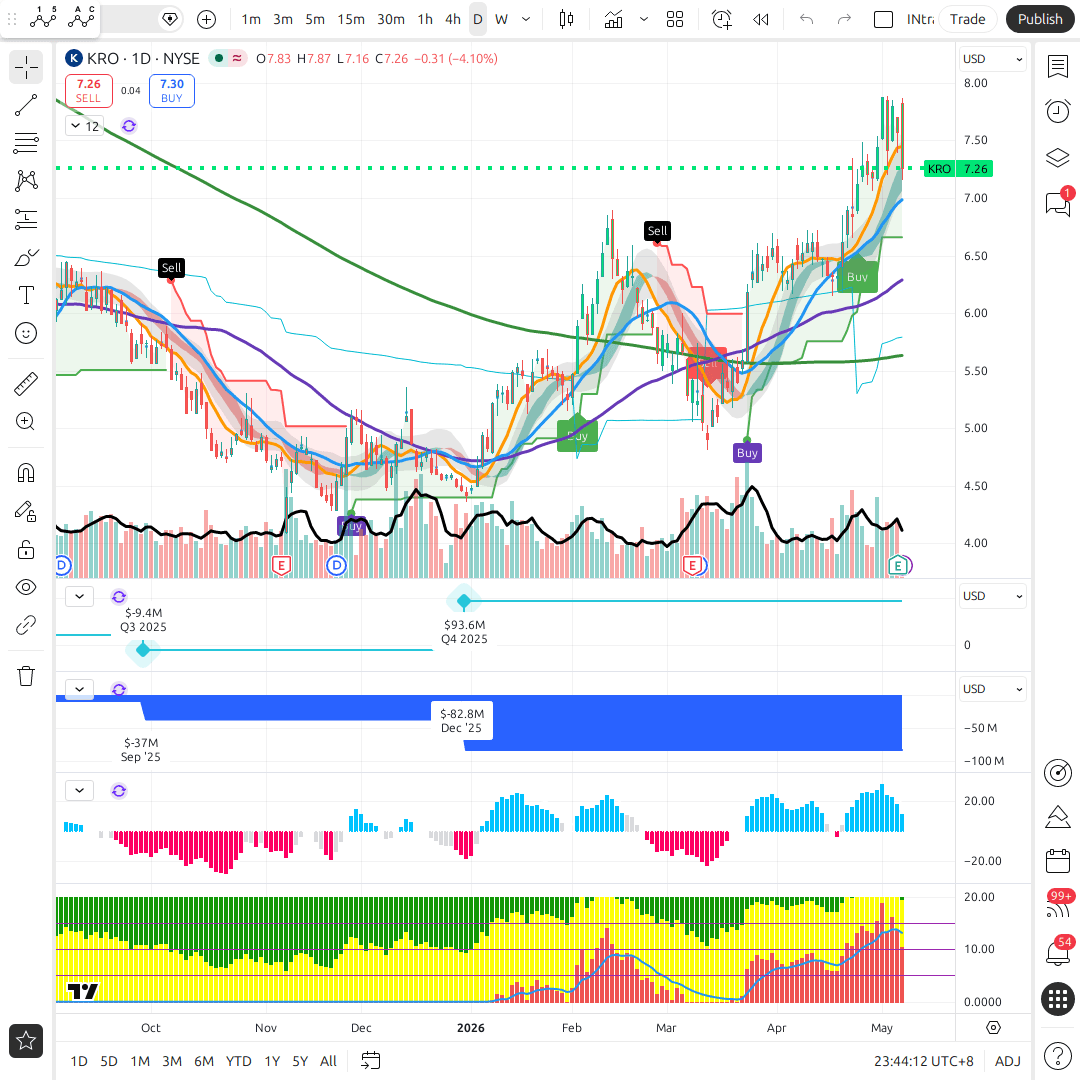
KR Chart
1D • NYSE
7 May, 03:44 pm
195.9 KB
Company Profile: The Kroger Co. (KR) - A New Era After Albertsons
The Kroger Co. is going through one of the most dramatic transitions in its 100-plus-year history. After failing to merge with Albertsons in a $24.6 billion mega-deal, Kroger is now led by a former Walmart U.S. chief, and the new strategy is being staked directly against Walmart and Costco on the single most sensitive battlefield for shoppers: price.
Shariah Status: NON-COMPLIANT
Before reading further, this matters most: Kroger does NOT pass Shariah screening. Two main reasons. First, its Debt-to-Equity (D/E) ratio sits at roughly 227 percent, far above the threshold allowed for conventional interest-bearing debt. Second, as a grocery retailer, part of Kroger's sales mix comes from alcohol and tobacco, which counts as impermissible revenue. For Shariah-screening investors, KR is automatically excluded from the investable universe regardless of how compelling the fundamental or technical story looks. This report is prepared for educational and market-understanding purposes only.
The Foran-Era Pivot: A Former Walmart Boss Takes Over
Kroger's big story today starts with one name: Greg Foran. He joined Kroger in February 2025 and was formally appointed permanent CEO on February 9, 2026, succeeding Ron Sargent, who had served as Chairman and interim CEO since March 2025. Before Kroger, Foran was CEO of Walmart U.S. - meaning he comes from a company whose entire business DNA is built on 'everyday low price' and store-level operating discipline.
This is not just a routine leadership change, it is a clear strategic pivot. Bloomberg reported on May 21, 2026 that Kroger is planning its biggest price cuts in years, aimed squarely at challenging Walmart and Costco on price perception. It is a high-stakes bet: if it works, Kroger can reclaim market share that has been leaking to Walmart and Costco for years. If it fails, margins compress without enough volume to offset the pain.
After Albertsons: A Reset and Smaller-Scale M&A
To understand why Kroger needed this pivot, it helps to understand what failed before it. In 2022, Kroger announced a $24.6 billion mega-merger with Albertsons that would have created the largest grocery combination in the U.S. Courts and the FTC blocked the deal on antitrust grounds, citing reduced competition and weakened union bargaining leverage. Kroger formally terminated the deal on December 11, 2024.
What followed was litigation. Albertsons sued Kroger on December 10, 2024, seeking the $600 million break fee plus damages, alleging Kroger did not try hard enough to resolve regulatory divestiture requirements. Kroger countersued in March 2025, denying breach and alleging Albertsons secretly worked with C&S Wholesale Grocers to sabotage its own deal. That litigation is still ongoing, a genuine tail risk (potential $600 million-plus exposure) even if it is not solvency-threatening given Kroger's scale.
With the mega-merger route blocked, Kroger pivoted to smaller, regionally-focused bolt-on M&A. The latest example: the acquisition of Giant Eagle, a family-owned Pennsylvania/Ohio grocer with roughly $9 billion in annual sales, 197 supermarkets plus 11 standalone pharmacies across Northern Ohio, Western Pennsylvania, West Virginia, Maryland and Indiana, for $1.65 billion ($1.25 billion cash plus roughly $400 million in assumed liabilities). Giant Eagle will keep its own banner and brand, operating as a Kroger division, the same playbook used to integrate Harris Teeter and Fred Meyer. The deal is expected to be accretive to adjusted EPS in year two after closing.
Store Footprint and the Digital Growth Engine
Kroger operates more than 2,700 stores across the U.S. under multiple banners: Kroger, Ralphs, Fred Meyer, Harris Teeter, Fry's, King Soopers, Smith's, QFC and others. Headquarters are in Cincinnati, Ohio.
The most interesting part of Kroger's story right now is not the physical stores, it is digital. E-commerce sales grew 19 percent year-over-year in Q1 FY2026, far outpacing core in-store sales. Even more notable is Kroger Precision Marketing (KPM), Kroger's retail media unit that sells ad space to consumer brands using Kroger's actual customer purchase data. KPM profit grew more than 20 percent in Q1 FY2026. This is a high-margin engine that is becoming increasingly important to the overall profit mix, much the way Amazon's advertising business became a bigger profit driver than its core e-commerce operations.
Management
Greg Foran brings deep retail operating experience from Walmart U.S., plus prior international experience at Air New Zealand and Woolworths Australia. His appointment as permanent CEO after nearly a year as Kroger's president/COO suggests the Board wanted him to fully understand internal operations before handing over full authority, a more cautious approach than an outside hire stepping straight into the CEO seat.
Exclusive Gold Members Content
Get in-depth analysis, target prices, and investment recommendations with Gold Members subscription.
How to Get Gold AccessCANSLIM Analysis
Exclusive Gold Members Content
Get in-depth analysis, target prices, and investment recommendations with Gold Members subscription.
How to Get Gold AccessFinancial Analysis
Q2 FY2026 (ended August 15, 2026) sales came in at $34.6 billion. GAAP operating profit was $971 million, while adjusted FIFO operating profit was $1,076 million. Gross margin was 22.4% (vs 22.5% a year ago) — nearly stable, and the FIFO gross margin excluding rent, D&A and fuel actually rose 13 basis points YoY, pointing to effective cost management amid soft sales.
| Metric | Q2 FY2026 | Q2 FY2025 |
|---|---|---|
| Sales | $34.6bn | ~$33.6bn* |
| Operating Profit (GAAP) | $971mn | — |
| Adjusted FIFO Operating Profit | $1,076mn | — |
| Adjusted EPS | $1.09 | $1.04 |
| Identical Sales (ex-fuel) | +0.2% | +3.4% |
| Gross Margin | 22.4% | 22.5% |
*Estimated based on reported growth rate.
Exclusive Gold Members Content
Get in-depth analysis, target prices, and investment recommendations with Gold Members subscription.
How to Get Gold AccessDividends
Kroger's board raised the quarterly dividend by 11% to an annualized rate of $1.56 (from $1.40) in June 2026 — the 20th consecutive year of dividend increases, with a 13% compound annual growth rate since the dividend was reinstated in 2006. At the current price of ~$58.60, that's a yield of roughly 2.7%.
Exclusive Gold Members Content
Get in-depth analysis, target prices, and investment recommendations with Gold Members subscription.
How to Get Gold AccessValuation
Exclusive Gold Members Content
Get in-depth analysis, target prices, and investment recommendations with Gold Members subscription.
How to Get Gold AccessPeer Comparison: KR vs Walmart, Costco & US Retail Peers
Exclusive Gold Members Content
Get in-depth analysis, target prices, and investment recommendations with Gold Members subscription.
How to Get Gold AccessRed Flags
Exclusive Gold Members Content
Get in-depth analysis, target prices, and investment recommendations with Gold Members subscription.
How to Get Gold AccessScorecard
Exclusive Gold Members Content
Get in-depth analysis, target prices, and investment recommendations with Gold Members subscription.
How to Get Gold AccessCatalysts
Exclusive Gold Members Content
Get in-depth analysis, target prices, and investment recommendations with Gold Members subscription.
How to Get Gold AccessConclusion
Exclusive Gold Members Content
Get in-depth analysis, target prices, and investment recommendations with Gold Members subscription.
How to Get Gold AccessKey Figures Behind The Kroger Co.
Corporate figure profiles associated with this stock.

Related Stocks
Other stocks in the Consumer Defensive sector