AbbVie Inc. (ABBV)
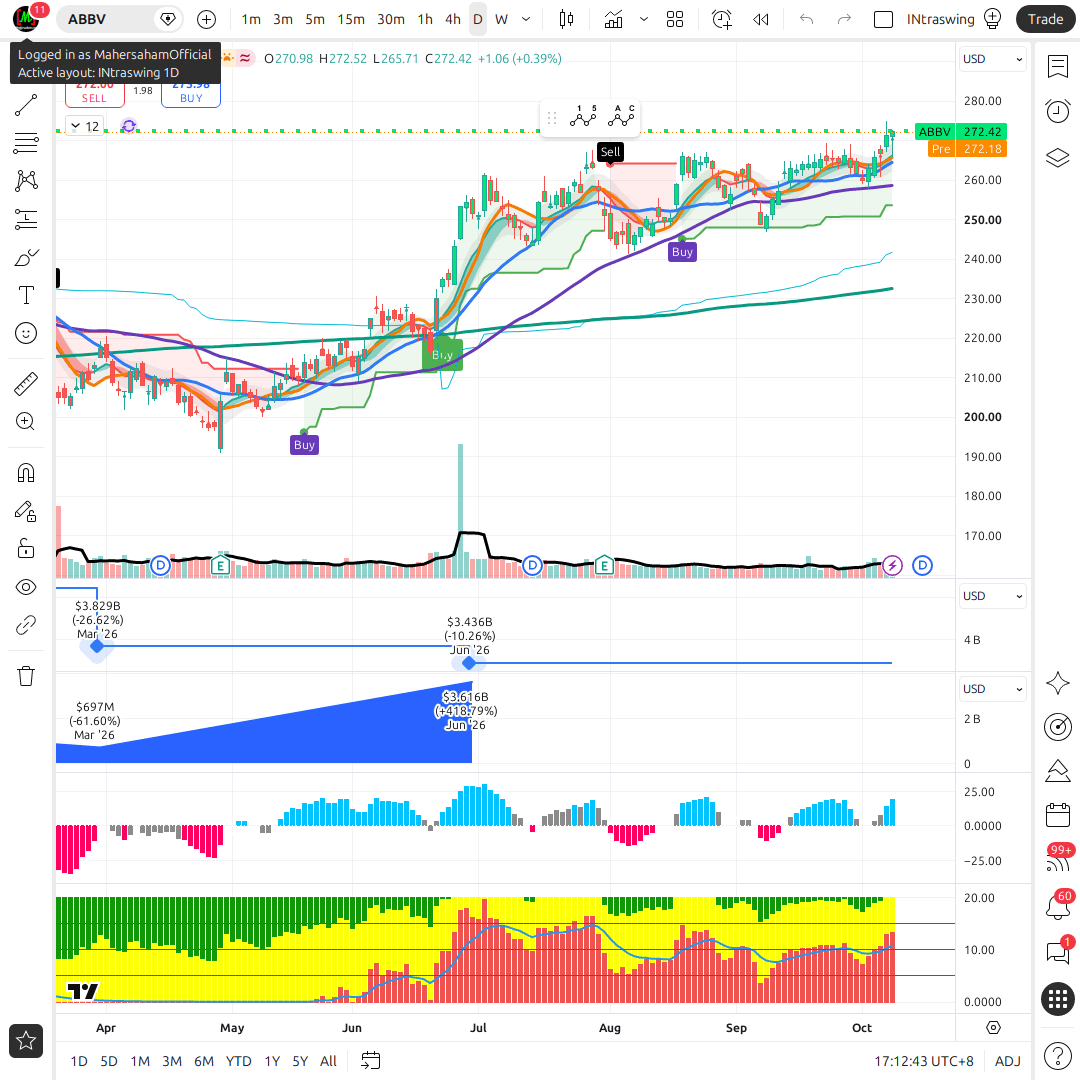
ABBV Chart
1D • NYSE
9 Oct, 09:12 am
175.6 KB
Company Profile
The Biggest Story in Big Pharma: Replacing Your Own Best-Selling Drug
If you follow the pharmaceutical sector, AbbVie (ABBV) is the most interesting case study right now. Why? Because the company is doing something that rarely succeeds in big pharma history — replacing its own blockbuster drug before the patent cliff kills it.
The short version: Humira used to be the world's best-selling drug, peaking at roughly $21.2 billion in sales in 2022. Once the patent expired and biosimilars flooded the market, Humira sales collapsed to under $9 billion by 2024, with FY2026 guidance sitting at just ~$2.9 billion. For most companies, losing your most profitable product would trigger a long, painful decline.
AbbVie prepared for this years in advance. They built two next-generation drugs — Skyrizi and Rinvoq — specifically to fill the gap Humira would leave, in the same immunology category (psoriasis, arthritis, Crohn's disease, and more). The results have been impressive: Skyrizi is guided to hit ~$21.6 billion in FY2026, while Rinvoq is guided to ~$10.2 billion. Combined, these two drugs are growing over 20% a year — comfortably outpacing Humira's decline. Many analysts consider this the best-executed patent-cliff transition in modern big pharma history, outperforming what most investors expected when Humira first lost exclusivity in 2023.
Segment Revenue Breakdown (Q1 2026)
| Segment | Q1 2026 Revenue | Growth (Reported) | Key Drugs |
|---|---|---|---|
| Immunology | $7.290B | +16.4% | Skyrizi, Rinvoq, Humira |
| Neuroscience | $2.875B | +26.0% | Vraylar, Botox Therapeutic, Ubrelvy/Qulipta, Vyalev |
| Oncology | $1.631B | -0.2% | Venclexta, Imbruvica, Elahere (ADC) |
| Aesthetics | $1.186B | +7.6% | Botox Cosmetic, Juvederm |
Notice Neuroscience is growing the fastest — largely thanks to the Cerevel Therapeutics acquisition (2024), which added a schizophrenia pipeline and other neurological disorder candidates. Oncology is roughly flat, but AbbVie just entered the ADC (antibody-drug conjugate) space through the ImmunoGen acquisition — so this is a future growth area, not a today story yet.
Key Corporate Actions
- Cerevel Therapeutics (August 2024) — $8.7B all-cash, added a neuroscience pipeline (schizophrenia). Note: not expected to be earnings-accretive until 2030 — a long-term bet, not a quick win.
- ImmunoGen (2024) — $10.1B, closed ahead of schedule, added an ADC platform for oncology.
Both deals reflect AbbVie's push to reduce its dependence on immunology alone — diversifying into neuroscience and oncology so that any concentration risk around Skyrizi/Rinvoq doesn't sink the whole company.
Management
AbbVie's CEO is Rob Michael, who took over in July 2024 and was also appointed Chairman of the board starting July 2025 — now holding both roles. He previously served as AbbVie's CFO, so management's focus tends to skew toward capital allocation discipline and cost control, which shows up in how the company handles M&A and buybacks.
Shariah Compliance Status
Per our database, ABBV is rated SHARIAH COMPLIANT. ⚠️ That said, this status can fluctuate given the company's relatively elevated debt ratio — some external screeners have flagged ABBV as non-compliant at certain points. See the Red Flags section for the full explanation.
Exclusive Gold Members Content
Get in-depth analysis, target prices, and investment recommendations with Gold Members subscription.
How to Get Gold AccessCANSLIM Analysis
Exclusive Gold Members Content
Get in-depth analysis, target prices, and investment recommendations with Gold Members subscription.
How to Get Gold AccessFinancial Analysis
The real story: strong revenue, EPS trimmed by asset-purchase charges
Q2 2026 revenue was $16.990 billion, up 10.2% (9.5% operational). For the first half, revenue was about $32.0 billion. The FY2026 revenue guide was raised by roughly $300 million to about $67.6 billion.
| Segment (Q2 2026) | Revenue | Growth |
|---|---|---|
| Immunology | $8.786 billion | +15.1% |
| Neuroscience | $3.228 billion | +20.3% |
| Oncology | $1.650 billion | -1.5% |
| Aesthetics | $1.282 billion | +0.3% |
Skyrizi reached $5.505 billion (+24.4%), Rinvoq $2.525 billion (+24.5%), while Humira fell 35.9% to $756 million. Skyrizi plus Rinvoq ($8.03 billion) is now nearly half of company revenue, and Humira is only about 4%.
| Metric | Q2 2026 |
|---|---|
| GAAP EPS | $2.03 (+290% YoY) |
| Adjusted EPS | $3.65 (+22.9%) |
| Operating margin (adjusted) | 48.3% (GAAP 37.9%) |
| Gross margin (adjusted) | 84.7% (GAAP 74.7%) |
The GAAP versus adjusted gap ($2.03 versus $3.65) is mostly amortization of intangibles from past acquisitions. Do not read raw GAAP P/E.
Exclusive Gold Members Content
Get in-depth analysis, target prices, and investment recommendations with Gold Members subscription.
How to Get Gold AccessDividends
Dividend holds at $1.73 a quarter, no new raise since February
AbbVie declared a quarterly dividend of $1.73 per share on 10 September 2026, payable 16 November 2026 to holders of record on 15 October 2026. It was raised 5.5% (from $1.64) effective February 2026 and has not changed since. The full-year run rate is $6.92 per share.
At $263.85, the yield is about 2.6%, lower than the ~2.8% in July because the price has risen. AbbVie is a member of the S&P Dividend Aristocrats.
On the midpoint of FY2026 adjusted EPS guidance ($13.86), the payout ratio is about 50%. That looks comfortable, but see the gold section for actual cash coverage.
Exclusive Gold Members Content
Get in-depth analysis, target prices, and investment recommendations with Gold Members subscription.
How to Get Gold AccessValuation
Exclusive Gold Members Content
Get in-depth analysis, target prices, and investment recommendations with Gold Members subscription.
How to Get Gold AccessPeer Comparison
Exclusive Gold Members Content
Get in-depth analysis, target prices, and investment recommendations with Gold Members subscription.
How to Get Gold AccessRed Flags
Exclusive Gold Members Content
Get in-depth analysis, target prices, and investment recommendations with Gold Members subscription.
How to Get Gold AccessScorecard
Exclusive Gold Members Content
Get in-depth analysis, target prices, and investment recommendations with Gold Members subscription.
How to Get Gold AccessCatalysts
Exclusive Gold Members Content
Get in-depth analysis, target prices, and investment recommendations with Gold Members subscription.
How to Get Gold AccessConclusion
Exclusive Gold Members Content
Get in-depth analysis, target prices, and investment recommendations with Gold Members subscription.
How to Get Gold AccessRelated Stocks
Other stocks in the Healthcare sector