PepsiCo Inc (PEP)
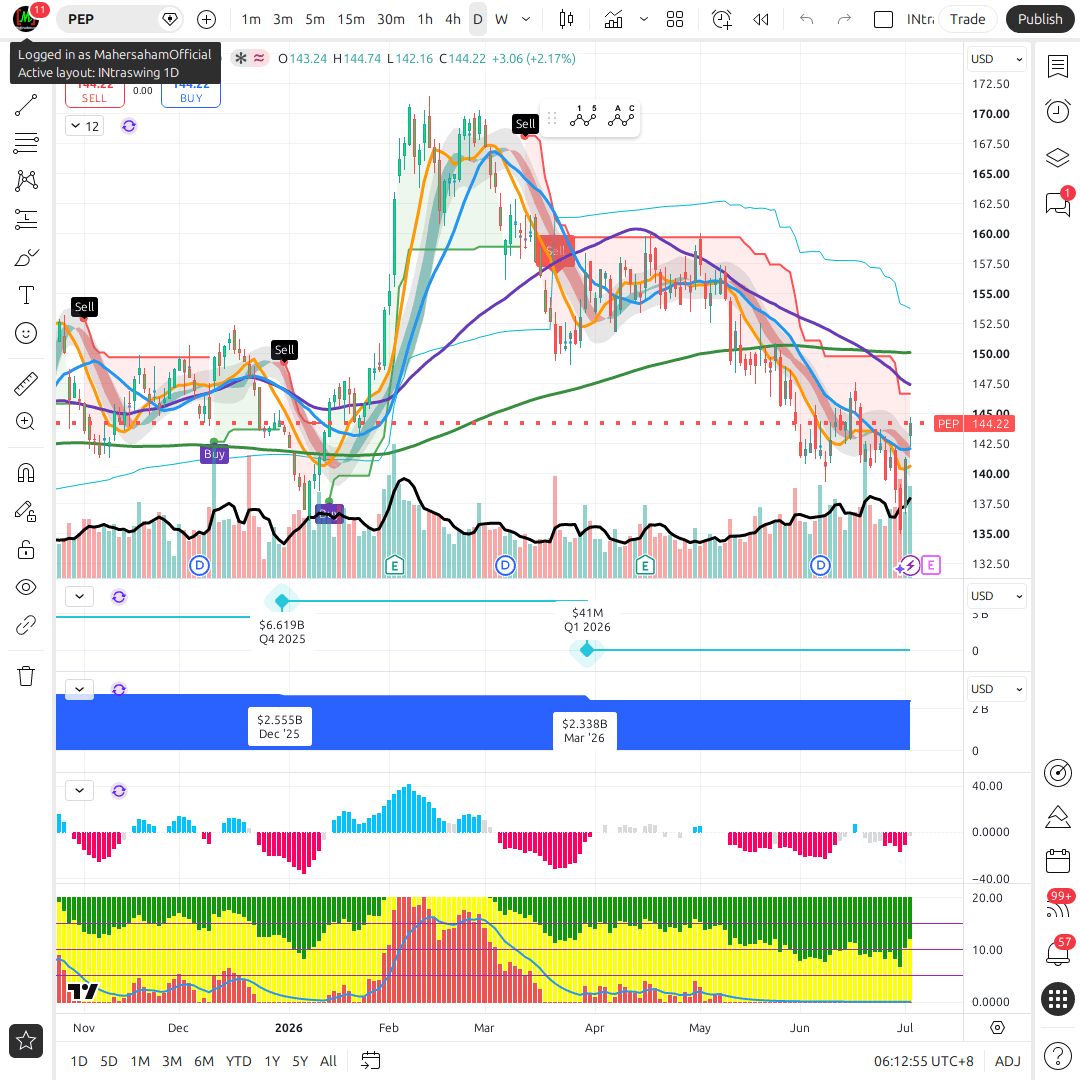
PEP Chart
1D • NASDAQ
3 Jul, 10:12 pm
213.6 KB
Company Profile
PepsiCo Under Activist Pressure - And Actually Responding
PepsiCo's story right now is not simply 'giant snacks-and-beverage company.' Since September 2025, Elliott Management - one of Wall Street's most feared activist funds - disclosed a stake of roughly USD4 billion in PepsiCo and went on the offensive: Elliott labeled PepsiCo a 'dramatic underperformer,' citing a lack of strategic clarity, decelerating growth, and eroding profitability, particularly in North America. Elliott's primary target was PepsiCo Beverages North America (PBNA), which has been steadily losing market share to Coca-Cola, and the fund openly proposed refranchising PepsiCo's company-owned bottling network to independent bottlers - mirroring the asset-light model Coca-Cola adopted years ago.
How Management Responded
CEO Ramon Laguarta did not sit still. Between December 2025 and February 2026, PepsiCo announced a North America supply chain review and aggressive cost cuts. Most notably: in February 2026, PepsiCo cut prices on core snack brands like Lay's and Doritos by up to 15% - a drastic move to counter volume pressure and softening demand partly linked to GLP-1 drugs (Ozempic and similar) reshaping consumer snacking habits. After months of pressure, PepsiCo and Elliott reached a settlement - a signal that activist pressure here actually produced concrete management action, not just media theater.
Business Structure: Four Core Segments
Operationally, PepsiCo is organized into several key segments: Frito-Lay North America (PFNA) - the core snacks business (Lay's, Doritos, Cheetos), which posted FLAT volume in Q2 2026 as management chose to sacrifice margin for market share retention through affordability investments; PepsiCo Beverages North America (PBNA) - the segment most heavily criticized by Elliott, where operating margin fell 90 basis points in the latest quarter due to commercial arrangements tied to the Alani brand plus soft convenience-channel performance; Quaker Foods North America - the oatmeal and cereal business, also soft; and the International segment (Asia Pacific, Europe/Middle East/Africa, Latin America), now the company's primary growth engine, with international operating margin expanding 100 basis points in the same quarter thanks to improved operating efficiency.
Leadership and Shariah Status
Ramon Laguarta leads PepsiCo as Chairman and CEO, tasked with steering the company through the most intense period of activist pressure in its corporate history. From a Malaysian investor's perspective, PepsiCo is classified as Shariah-Compliant - its core business (food and beverage manufacturing and distribution) passes standard activity screening, though as always, verify current status against your reference Shariah screening list before making investment decisions, as compliance status can shift with the company's financial ratios over time.
Exclusive Gold Members Content
Get in-depth analysis, target prices, and investment recommendations with Gold Members subscription.
How to Get Gold AccessCANSLIM Analysis
Exclusive Gold Members Content
Get in-depth analysis, target prices, and investment recommendations with Gold Members subscription.
How to Get Gold AccessFinancial Analysis
The story of the latest quarter is better top-line growth with thinner underlying margins. Q3 2026 (12 weeks ended 5 September 2026) net revenue was $25,274 million, up 5.6%, with organic growth of 3.1%. Operating profit was $4,260 million (+19%), but that headline is helped by weak prior-year charges, and core operating margin actually slipped to 16.9% from 17.3%. Total volume fell 1% in the quarter.
| Metric | Q3 2026 | Q3 2025 / Change |
|---|---|---|
| Net revenue | $25,274 million | +5.6% |
| Organic revenue | +3.1% | Best since Q4 2023 |
| GAAP EPS | $2.23 | $1.90 (+17%) |
| Core EPS | $2.34 | $2.29 (+2%) |
| Core operating margin | 16.9% | 17.3% (-35 basis points) |
| Total volume | -1% | Year to date -2% |
Cash generation is the bright spot. Year-to-date operating cash flow was $7,950 million versus $5,468 million a year ago, and free cash flow (our derivation: operating cash flow less capex of $2,182 million) was about $5.9 billion versus about $3.2 billion.
Exclusive Gold Members Content
Get in-depth analysis, target prices, and investment recommendations with Gold Members subscription.
How to Get Gold AccessDividends
PepsiCo remains one of the most dependable dividend payers in the market. The board declared a quarterly dividend of $1.48 per share on 17 July 2026 (record date 4 September, paid 30 September), in line with the annualised rate of $5.92 that took effect from the June 2026 payment, up 4% from $5.69. At the 8 October close of $128.34 the trailing yield is about 4.6%, which is near the top of its own 10-year range.
| Item | Detail |
|---|---|
| Latest declaration | $1.48 per share (17 July 2026) |
| Annualised dividend | $5.92 (from $5.69, +4%) |
| Dividend yield at $128.34 | About 4.6% |
| Payout ratio | About 71% of earnings |
| FY2026 cash returns planned | $8.9 billion ($7.9 billion dividends, $1.0 billion buybacks) |
The streak of annual increases now runs for over five decades. The more relevant question for income investors is how much room there is to keep raising it while earnings growth is slowing.
Exclusive Gold Members Content
Get in-depth analysis, target prices, and investment recommendations with Gold Members subscription.
How to Get Gold AccessValuation
Exclusive Gold Members Content
Get in-depth analysis, target prices, and investment recommendations with Gold Members subscription.
How to Get Gold AccessPeer Comparison
Exclusive Gold Members Content
Get in-depth analysis, target prices, and investment recommendations with Gold Members subscription.
How to Get Gold AccessRed Flags & Risks
Exclusive Gold Members Content
Get in-depth analysis, target prices, and investment recommendations with Gold Members subscription.
How to Get Gold AccessScorecard
Exclusive Gold Members Content
Get in-depth analysis, target prices, and investment recommendations with Gold Members subscription.
How to Get Gold AccessFuture Catalysts
Exclusive Gold Members Content
Get in-depth analysis, target prices, and investment recommendations with Gold Members subscription.
How to Get Gold AccessConclusion
Exclusive Gold Members Content
Get in-depth analysis, target prices, and investment recommendations with Gold Members subscription.
How to Get Gold AccessRelated Stocks
Other stocks in the Consumer Defensive sector