Why Is Forex Haram? 5 Key Reasons & Malaysia's Official Fatwa

Why Is Forex Haram? 5 Key Reasons & Malaysia's Official Fatwa (2026)
Why is forex haram? This is one of the most frequently asked questions by Malaysians, especially among young people drawn to the promise of "making money from home." With forex promotions flooding social media — promising huge returns in a short time — many are confused about whether forex is truly haram or if there's still room to do it in a halal way.
This article answers that question clearly based on official fatwas, scholarly opinions, and Malaysian law.
Quick Answer
Yes, individual forex trading through electronic platforms is haram according to the Muzakarah (National Fatwa Council Committee). It is haram because it contains elements of riba (interest), gharar (excessive uncertainty), maysir (gambling), no real asset ownership, and the combination of lending with trading. Additionally, it also violates Malaysian law under the Exchange Control Act 1953 and carries penalties of up to RM1 million in fines or 5 years imprisonment.
What Is Forex?
Forex stands for Foreign Exchange — the trading of foreign currencies. For example, you buy US Dollars (USD) with Ringgit Malaysia (MYR) at a certain price, then sell it back when the price rises to make a profit.
In this context, the forex being discussed is not the currency exchange you do at a regular money changer. The issue lies with individual spot forex trading — currency trading done by individuals through online platforms like MetaTrader, typically offered by overseas brokers.
The basic concept of forex is legitimate and necessary in the global economy. Banks, multinational corporations, and governments exchange currencies daily for international trade. However, the problem lies in how it is done by individuals through electronic platforms, which violates several key principles in Islam.
Malaysia's National Fatwa Ruling
The Muzakarah of the National Fatwa Committee for Islamic Religious Affairs of Malaysia has ruled that:
"The trading of foreign currency (forex) by individuals on a spot basis (individual spot forex) through electronic platforms is HARAM as it contradicts the requirements of Shariah. This ruling does not apply to foreign currency exchange operations conducted at licensed money changer counters and those handled by licensed financial institutions under Malaysian law."
This fatwa is not merely one scholar's personal opinion — it is an official ruling made by a panel of scholars at the national level after thoroughly examining the fiqh muamalat aspects and the realities of modern forex operations.
5 Key Reasons Why Forex Is Haram
1. Riba (Interest/Usury)
This is the most fundamental reason. In forex trading, elements of riba exist through:
- Rollover interest / swap fee: When you hold a trading position overnight, the broker charges or pays interest based on the interest rate differential between the two currencies. This clearly constitutes riba al-nasi'ah (interest due to deferment).
- Margin trading: Brokers lend money to traders through leverage (e.g., 1:100 means you only need RM1,000 to control a position worth RM100,000). This loan involves costs — directly or indirectly — which constitute riba.
In Islam, currency exchange (bay' al-sarf) requires that the exchange occurs in cash and immediately (taqabudh). Any delay renders the transaction as containing riba.
2. Gharar (Excessive Uncertainty)
Gharar means excessive uncertainty or ambiguity in a transaction. In forex:
- Currency prices change every second based on factors that are difficult to predict
- Traders don't know the exact value they will receive when the transaction is completed
- The spread (difference between buy and sell prices) fluctuates and is sometimes not transparent
Prophet Muhammad (peace be upon him) prohibited transactions containing excessive gharar as it can cause injustice to one party. In forex, the level of uncertainty is extremely high — unlike buying and selling physical goods where the value and quantity are clearly known.
3. Maysir (Gambling and Speculation)
Maysir refers to gambling where a person stakes their wealth hoping for multiplied returns, but also risks losing everything. In forex:
- Most retail traders speculate on price direction — not based on sound fundamental analysis
- Statistics show that over 70-80% of retail traders lose money in forex trading
- The use of leverage multiplies both profits and losses — similar to betting
According to the Federal Territory Mufti's Office, the speculative element in forex has exceeded the level permitted by Shariah and falls into the category of prohibited maysir.
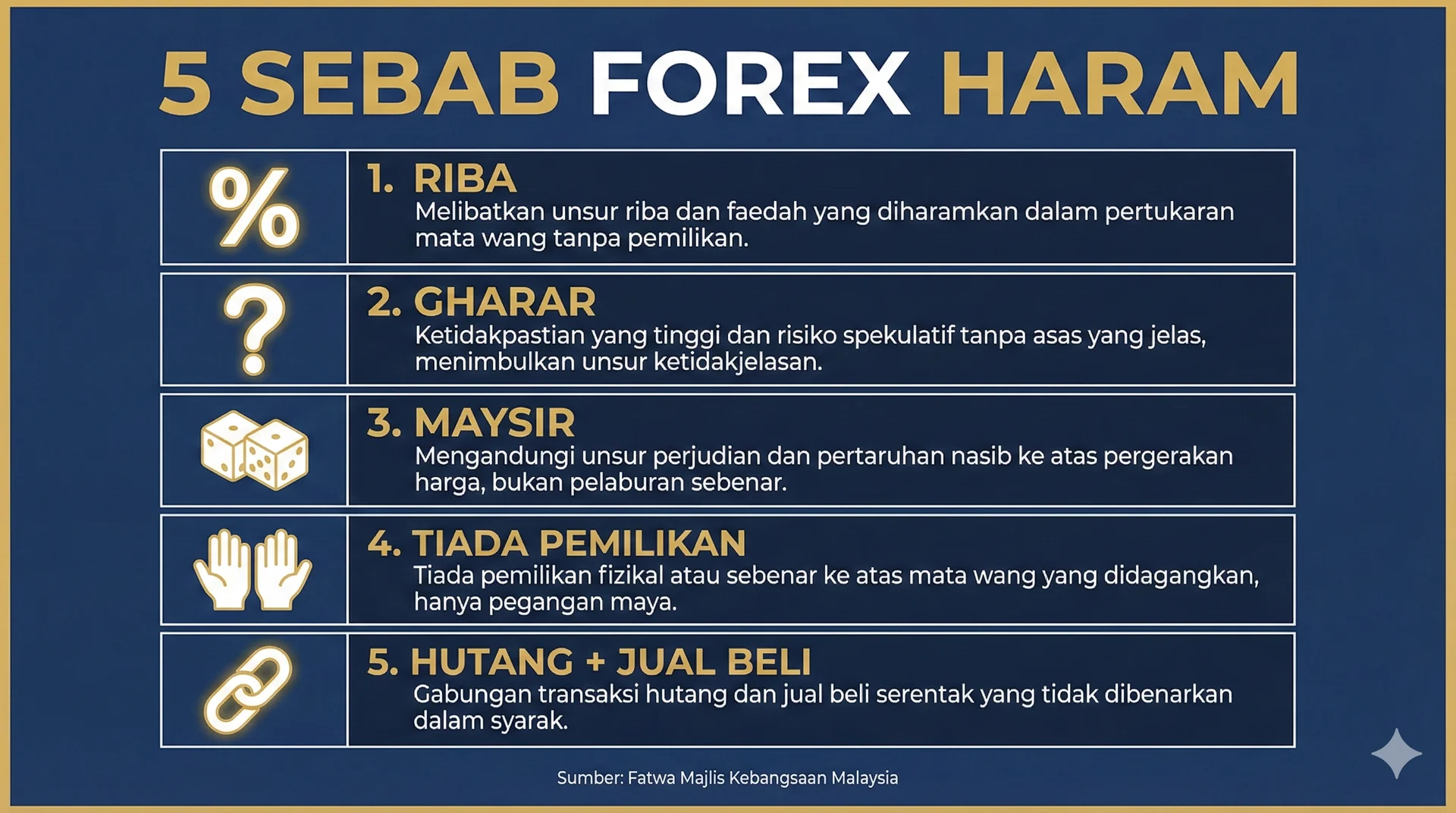
4. No Real Ownership
In Islamic transactions, the seller must own the goods being sold. In forex trading:
- Traders don't actually own the currencies being traded
- Transactions are merely Contracts for Difference (CFD)
- No physical delivery (taqabudh) of currencies occurs between the two parties
This violates the fundamental requirement of bay' al-sarf which mandates that both parties receive the goods before parting from the transaction session.
5. Combining Debt and Trade (Al-Salaf wa Al-Bay')
Islam prohibits transactions that combine lending with a condition to trade. In forex:
- The broker acts as both a lender (through leverage) AND a party that takes commission from the transaction
- Traders borrow from the broker to execute trades, while the broker simultaneously profits from spreads and commissions
- This concept is known as al-salaf wa al-bay' which is explicitly prohibited in the hadith of Prophet Muhammad (peace be upon him)
Forex Is Illegal Under Malaysian Law
Beyond being haram from an Islamic perspective, individual forex trading also violates Malaysian law. According to Bank Negara Malaysia (BNM):
- The Exchange Control Act 1953 prohibits any individual other than authorized dealers (licensed financial institutions) from buying or selling foreign currency
- Offenders face fines of up to RM1 million or imprisonment of up to 5 years, or both
- Participants who join illegal forex schemes can also be charged as abettors
The Securities Commission Malaysia (SC) also maintains an Investor Alert List that includes hundreds of unlicensed forex entities operating illegally in Malaysia.
The reality is, most forex brokers promoted on Malaysian social media are not licensed by BNM or SC. They operate from overseas and are not subject to Malaysian legal protections — meaning if you lose your money, no authority can help you.
What About Money Changers?
Many are confused — if forex is haram, what about exchanging money at a money changer?
Currency exchange at licensed money changers is HALAL and is not covered by the forex prohibition fatwa. This is because:
- The exchange happens in cash and immediately — you pay RM and receive USD on the spot
- No leverage or loans are involved
- No speculative element — you're exchanging money for actual use (travel, paying fees, etc.)
- Licensed under the Money Services Business Act 2011
Similarly, currency exchange handled by licensed financial institutions like banks is halal as it meets the requirements of bay' al-sarf.
Services like Wise (formerly TransferWise) also fall under the permissible category as they perform actual currency exchange for money transfer purposes, not speculation.
Halal Investment Alternatives in Malaysia
If you're interested in investing and generating passive income, there are many halal alternatives that are far safer and more profitable in the long run:
Shariah-Compliant Stocks on Bursa Malaysia
Bursa Malaysia has over 700 stocks recognised as Shariah-compliant by the SC's Shariah Advisory Council. You can buy and sell these stocks through a legitimate CDS account. This is a transparent, regulated investment where you actually own the assets.
ASB (Amanah Saham Bumiputera) & Tabung Haji
ASB (Amanah Saham Bumiputera) and Tabung Haji are two popular savings and investment instruments among Malaysians. Both offer consistent dividends and are recognised as halal by religious authorities.
Physical Gold
Physical gold investment — whether in the form of bars or dinars — is halal as long as the exchange is done in cash and immediately. Gold prices have also shown consistent upward trends over the long term.
Shariah-Compliant Unit Trusts
There are many unit trust funds managed in a Shariah-compliant manner by licensed fund managers. This is suitable for investors who prefer not to manage their own portfolios.
FAQ (Frequently Asked Questions)
Is forex 100% haram with no exceptions?
Forex trading by individuals through electronic platforms is haram according to the fatwa. However, currency exchange at licensed money changers and through licensed financial institutions is halal.
What about "Islamic" or "swap-free" forex accounts?
Some brokers offer "Islamic" accounts that supposedly eliminate swap/interest. However, the fatwa's issues are not limited to riba alone — it also involves gharar, maysir, and no real ownership. Therefore, the "Islamic" label on a forex account does not make it halal.
Can you learn forex without making real transactions?
According to the Federal Territory Mufti's Office, using forex platforms for learning purposes only (without any actual transactions) is permissible. This includes demo accounts for studying technical and fundamental analysis.
What is the ruling on buying foreign currency for savings?
Buying foreign currency in cash (e.g., buying USD at a money changer for savings) is permissible as long as the exchange occurs immediately and in cash. This differs from forex trading which involves online platforms and leverage.
Why do many people still trade forex despite it being haram?
Several reasons: (1) unaware of the fatwa, (2) influenced by social media promotions, (3) deceived by promises of high returns, and (4) assuming the "Islamic account" label is sufficient to make it halal. This is why Islamic financial education is critically important.
Is cryptocurrency also haram like forex?
The ruling on cryptocurrency is different and still under discussion. SC Malaysia has approved several licensed crypto platforms (such as Luno and Tokenize). However, each case should be referred to the latest guidelines from religious authorities as it involves a different discussion from forex.
What are the legal risks if you continue trading forex?
You can be charged under the Exchange Control Act 1953 with fines of up to RM1 million or imprisonment of up to 5 years. Participants can also be charged as abettors.
How do you know if an investment is legitimate or a scam?
Check the SC Malaysia Investor Alert List and the BNM Financial Consumer Alert first. If the entity is not on the licensed list, do not invest.
Conclusion
Individual forex trading through electronic platforms is haram according to Malaysia's official fatwa due to elements of riba, gharar, maysir, no real asset ownership, and combining debt with trade. It also violates Malaysian law and carries severe penalties. The good news — there are plenty of halal investment alternatives that are safer and more transparent.
Start Investing the Halal Way
Instead of taking risks with forex that is both haram and illegal, you can start your halal investment journey on the right foot — directly on Bursa Malaysia through Shariah-compliant stocks.
Open a CDS Trading Account through Mplus to start buying Shariah-compliant stocks on Bursa Malaysia with step-by-step guidance.
Download the Free Stock Market Basics Ebook to understand the fundamentals of stock investing before you begin — a complete guide for beginner investors.
Further Reading
- Forex Ruling by the National Fatwa Council — The full official fatwa ruling on forex in Malaysia
- How to Use Wise for Halal Forex — A legitimate and halal currency exchange alternative
- How to Purify Non-Shariah Compliant Wealth — A guide if you've been involved in non-compliant investments
- Complete Guide to Start Investing in Stocks (2026) — Step-by-step guide for beginner investors
- Non-Existent Investments on Facebook & Telegram Malaysia — Recognise investment scams that are rampant