Average Price in Stocks: How to Calculate, Average Up & Average Down

What Is Price Averaging
Price averaging refers to the average cost price of the lots you hold. It happens whenever you buy the same counter on Bursa Malaysia at different prices, whether on the same day or on different days.
Your broker combines every purchase and returns a single number: the average price. That is the figure shown in your portfolio as your average cost.
Be aware, though, that price averaging can carry high risk if it is used without a basis. Many investors who refuse to cut loss lean on this technique purely because they are convinced the price has to recover.
Price averaging only suits stocks whose company fundamental analysis is sound. If the stock is purely speculative, the risk is very high.
My Stock Is Rising and I Want to Add: Should I Sell First or Just Buy More?
This is a question investors ask often. The short answer: if you still believe in the stock and simply want to increase your holding, just buy more. There is no need to sell first. Selling and then buying back at the same price does not add a single sen to your profit. It only adds brokerage, stamp duty and clearing fees twice over, plus the risk that the price runs away before you can get back in.
The main reason people consider selling first is that they want their average price to look "tidier". The problem is that selling and rebuying at the current price actually makes your average price higher, not lower. So it does not even achieve the original goal.
Comparing the Two Paths
Say you hold 1,000 units of stock Y at a cost of RM1.00 per unit (total cost RM1,000). The price is now RM1.50 and you want to hold 1,500 units in total.
| Path A: Just add | Path B: Sell first, buy back | |
|---|---|---|
| Action | Buy 500 units @ RM1.50 | Sell 1,000 @ RM1.50, buy 1,500 @ RM1.50 |
| Final unit count | 1,500 units | 1,500 units |
| Total cost | RM1,750 | RM2,250 |
| Average price | RM1.167 | RM1.500 |
| Market value | RM2,250 | RM2,250 |
| Unrealised profit | RM500 | RM0 |
| Realised profit | RM0 | RM500 |
| Actual total profit | RM500 | RM500 |
| Number of transactions | 1 purchase | 1 sale + 1 larger purchase |
Look at the row above the transaction count. Both paths leave you with 1,500 units and RM500 in profit. The only difference is where that profit sits: inside the portfolio (unrealised) or in your cash account (realised).
What genuinely differs is the cost. Path B forces you to churn the original 1,000 units for no economic benefit at all.
The Real Cost of Selling First
Every time you buy or sell on Bursa Malaysia, three fixed costs apply. The official list is on the Bursa Malaysia Transaction Costs page:
- Brokerage - varies by broker, typically a minimum of RM8 to RM12 per order on online platforms.
- Clearing fee - 0.03% of transaction value, capped at RM1,000.
- Stamp duty - 0.1% of transaction value (RM1 for every RM1,000 or part thereof), capped at RM1,000 per contract note. This rate and cap apply to contract notes executed from 13 July 2023 to 12 July 2028, per the Stamp Duty Remission Order analysed by EY Malaysia.
Using the earlier example, the extra round trip in Path B involves a RM1,500 sale plus an additional RM1,500 of buying:
| Cost | RM1,500 sale | Extra RM1,500 purchase | Total |
|---|---|---|---|
| Brokerage (RM8 minimum) | RM8.00 | RM8.00 | RM16.00 |
| Clearing fee 0.03% | RM0.45 | RM0.45 | RM0.90 |
| Stamp duty 0.1% | RM2.00 | RM2.00 | RM4.00 |
| Total | RM10.45 | RM10.45 | RM20.90 |
RM20.90 on a RM1,500 position works out to roughly 1.4%. In other words, the stock has to climb another 1.4% just for you to break even on a round trip you never needed to make.
One point does work in a Malaysian investor's favour: selling shares listed on Bursa attracts no capital gains tax. According to EY's analysis of Malaysia's CGT regime, capital gains tax applies only to shares in unlisted companies, and shares listed on Bursa Malaysia are exempt. So selling does not trigger a tax bill. It still triggers a fee bill, and that alone is enough to make Path B the weaker choice.
The Bigger Risk: Not Getting Back In
That RM20.90 is still swallowable. The timing risk is far more dangerous.
Between the moment you sell and the moment you buy back, the price will not wait for you. If the stock gaps up to RM1.60 the next morning, the 1,500 units you planned to buy now cost RM2,400 instead of RM2,250. RM150 gone in an instant, seven times the fees above.
The psychological scenario is worse still. After selling at RM1.50, many investors baulk at buying back at RM1.60 because their mind is fixed on the price they just sold at. This is classic anchoring bias. The stock keeps running to RM2.00, RM2.50, and they never get back in. The RM500 they locked in looks small next to the move they missed.
In short, you swap a position in a stock you believe in for cash and a hope that you can re-enter at a comfortable price. That is not risk management, it is an extra bet you did not need to place.
Average Price Is an Accounting Number, Not a Measure of Profit
The real source of this confusion is the assumption that a lower average price means you are more profitable. That is not true.
Your profit is determined by two things only: how many units you hold, and how much money went in compared with the current market value. Average price is simply the quotient of those two. It is an accounting number, not a performance driver.
In the comparison table above, Path B produces an average price of RM1.50 that looks "worse" than the RM1.167 in Path A. Yet your actual wealth is the same. All that changed is the display in your portfolio.
If you find yourself making buy and sell decisions purely to prettify the average price figure, that is a sign you are managing a screen rather than managing an investment. The same trap operates at the opposite end, when investors keep adding to a broken stock purely to drag the average price down. Read more in Sunk Cost Fallacy.
How to Calculate Average Price
The basic formula is straightforward:
Average price = [(First purchase price x first purchase units) + (Next purchase price x next purchase units)] / (first purchase units + next purchase units)
An example with two purchases on different dates:
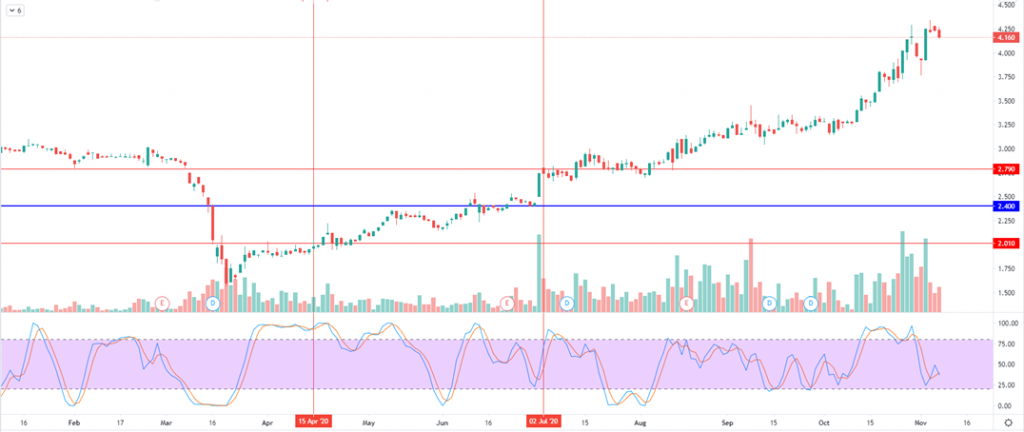
- 15 April 2020, buy 100 units of stock X at RM2.01
- 2 July 2020, buy 100 units of stock X at RM2.79
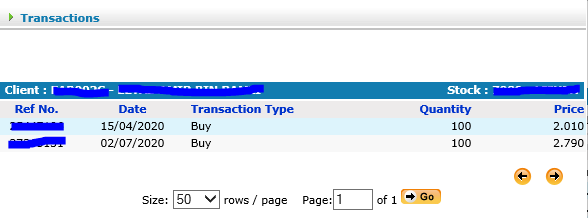
Average price = [(RM2.01 x 100) + (RM2.79 x 100)] / (100 + 100) = RM2.40
When the Price Rises: Average Up
Averaging up means adding to a position at a higher price than your original purchase, in order to maximise gains on a stock that has already proven it is moving in your favour.
The convention is to top up less than the original lot size. Why? Because the higher the price climbs, the greater the risk of a pullback. Adding in shrinking increments lets you build exposure without magnifying your loss if the trend reverses.
Example
- EP 1: 100 units of stock Y at RM1.00
- EP 2: 50 units of stock Y at RM1.50
Average Price = [(RM1.00 x 100) + (RM1.50 x 50)] / (100 + 50) = RM1.17
Notice the average price rises from RM1.00 to RM1.17, yet it still sits well below the RM1.50 market price. That is the advantage of adding in shrinking increments, a technique commonly called pyramiding.

When Averaging Up Makes Sense, and When It Does Not
Averaging up is not an automatic strategy. It makes sense only under certain conditions.
It makes sense when:
- Your original investment thesis is proving correct, for instance the company's financial results really are improving as you expected.
- The price breaks a key resistance level on convincing volume, rather than merely drifting up without support.
- Your position size is still below the limit you set for any single counter.
- You already know where the new stop loss will sit after the addition.
It does not make sense when:
- You are adding purely because the price is rising and you are afraid of missing out.
- The rise comes from rumour or sentiment with no change in fundamentals. That usually ends the way described in Buy the Rumour, Sell the News.
- Your position in that counter is already too large relative to your portfolio. See the Stop Loss & Position Sizing guide for setting sensible limits.
- You have just won several trades in a row and are starting to feel infallible. That is overconfidence bias, and it is expensive.
One important reminder: when you average up, your average price rises. That means the gap between your cost and your stop loss level narrows. If the price reverses, the larger position loses money faster than it would have before you added. This is exactly why the size of each addition must be controlled.
When the Price Falls: Average Down
Averaging down means adding to a position at a lower price to make it easier to reach breakeven, the point at which there is no loss. It is only justified if your research shows the stock's intrinsic value really is higher than the current market price.
In this case some investors top up more than the original lot size. However, this strategy carries very high risk. Make sure you only average down on quality counters, not penny stocks or counters lacking sound fundamental analysis.
Example
- EP 1: 100 units of stock Z at RM1.00
- EP 2: 200 units of stock Z at RM0.80
Average Price = [(RM1.00 x 100) + (RM0.80 x 200)] / (100 + 200) = RM0.87
The key distinction between averaging up and averaging down: averaging up adds to something that is working, while averaging down adds to something that is failing. The first is backed by market evidence, the second rests entirely on the accuracy of your own research.
Intraday Price Averaging
Here is how price averaging is calculated in intraday trading.
Remember: 1 lot = 100 units
Scenario 1: Buy twice, sell twice
- 9am - Buy stock A at RM0.50, 100 lots
- 10am - Sell stock A at RM0.51, 100 lots
- 11am - Buy stock A at RM0.55, 100 lots
- 4pm - Sell stock A at RM0.60, 100 lots
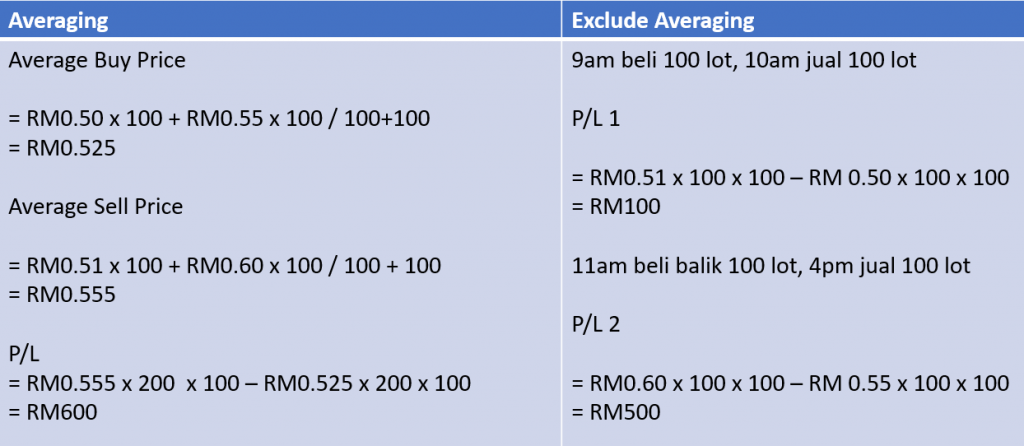
Scenario 2: Buy three times, sell twice
- 9.30am - Buy stock A at RM0.50, 100 lots
- 10am - Sell stock A at RM0.51, 100 lots
- 3pm - Buy stock A at RM0.52, 100 lots
- 4pm - Sell stock A at RM0.53, 100 lots
- 4.45pm - Buy stock A at RM0.55, 100 lots and hold overnight
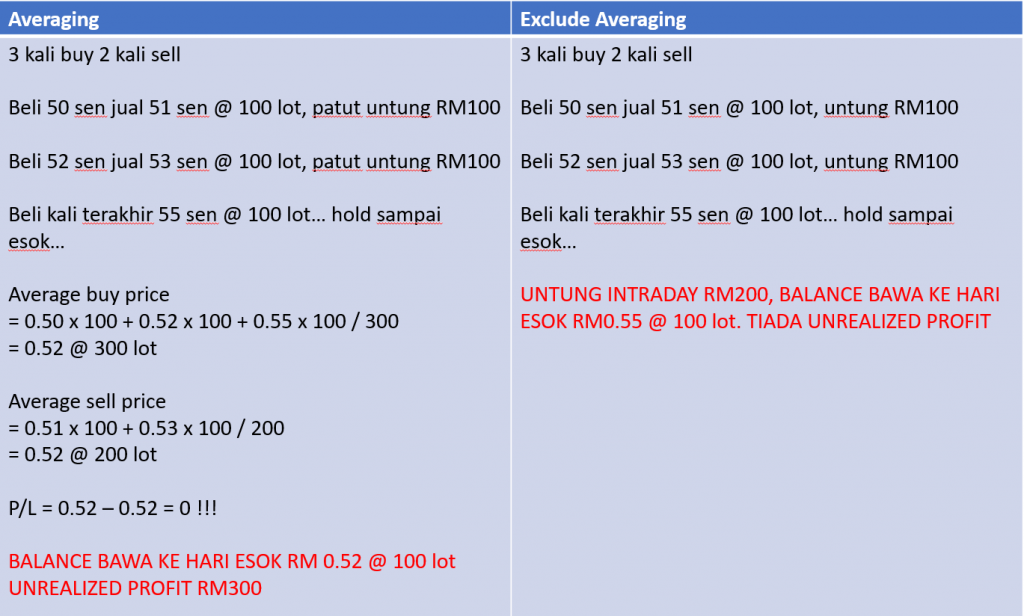
How does that RM300 unrealised profit arise? The latest price (the final purchase) is 55 sen and the average buy price is 52 sen. The final purchase of 100 lots equals 10,000 units.
Unrealised profit = (RM0.55 - RM0.52) x 10,000 units = RM300
Frequently Asked Questions (FAQ)
My stock is rising and I want to add. Should I sell first and buy back, or just buy more?
Just buy more. Selling and rebuying at the same price leaves you with the same unit count and the same total profit, but you pay brokerage, stamp duty and clearing fees twice. You also carry the risk of the price rising before you can get back in. Sell only if you genuinely want out of the stock, not to change your average price.
What is average price in stock investing?
Average price is the overall cost price calculated from the number of units and the different purchase prices. When you buy the same stock at different prices multiple times, your broker automatically calculates the overall average price of your holdings.
How do you calculate the average price of stocks?
Add up the value of all your purchases, then divide by the total number of units held. For example, if you buy 100 units at RM0.50 and another 100 units at RM0.52, your average price is RM0.51.
What is the difference between average down and average up?
Averaging down happens when you buy additional shares at a lower price than the original purchase, pulling the average price down. Averaging up happens when you buy at a higher price, pushing the average price up. Averaging up adds to a winning position, while averaging down adds to a losing one.
Does a lower average price mean I am more profitable?
Not necessarily. Profit is determined by how many units you hold and the difference between your total cost and the current market value. Average price is merely the accounting figure that results from that calculation. Two investors with different average prices can hold identical profits.
What are the transaction costs each time I buy or sell on Bursa Malaysia?
There are three main components: brokerage (typically a minimum of RM8 to RM12 per order on online platforms), a clearing fee of 0.03% capped at RM1,000, and stamp duty of 0.1% capped at RM1,000 per contract note. These costs apply separately to every purchase and every sale.
Do I pay capital gains tax when I sell Bursa-listed shares?
No. Shares listed on Bursa Malaysia are exempt from capital gains tax. Malaysia's capital gains tax applies only to shares in unlisted companies under specific conditions. That tax exemption does not make repeated buying and selling free, however, because transaction fees still apply.
How much should I add when averaging up?
Typically less than your original purchase size, for instance half. The reason is that the higher the price, the greater the risk of a reversal. Adding in shrinking increments lets you build exposure without sharply magnifying your loss if the trend turns. Also make sure your total position in a single counter stays within the limit you set for your portfolio.
Conclusion
Average price is a number produced by your buying pattern, not a determinant of whether you are up or down. When your stock is rising and you want to add, buying more directly is cheaper and safer than selling first in order to buy back.
Far more important than the average price calculation are your discipline around position sizing and the clarity of your investment thesis. Add because the company really is improving, not because the chart looked appealing that day.
Once you understand how average price works, the next step is putting it into practice in your own portfolio.
You can open a CDS trading account to start investing on Bursa Malaysia as well as in overseas markets such as the US and Hong Kong.
You can also get our free stock market basics ebook to learn the fundamentals of stock investing from scratch.
Further reading:
- Anchoring Bias in Stocks: Why Your Brain Clings to Your Original Entry Price
- Sunk Cost Fallacy: Why Investors Keep Averaging Down on Dead Stocks
- Stop Loss & Position Sizing: How to Protect Your Capital Before Buying
- Average Cost Calculation for Trading US and HK Stocks
- Prospect Theory: Why You Cut Winners Early but Hold Losers Forever