What's the Difference Between AC and DC? How It Connects Solar, EV Batteries and Bursa Malaysia Stocks

Every time you plug into a wall socket, you use AC. Every time you charge your phone, the charger converts AC to DC. The solar panels on your roof generate DC, but your appliances use AC. The battery in your electric vehicle (EV) stores DC, but the motor in that car actually uses AC.
The finance world mostly doesn't care about this - until they try to understand why Tenaga Nasional, Solarvest, Tesla, and NVIDIA are fundamentally connected. The key to understanding the modern energy investment ecosystem is first understanding the most basic difference in electricity: AC vs DC.
This article explains AC and DC technology in plain language, shows how it affects the grid, solar, and EV systems, and lists concrete listed companies on Bursa Malaysia and US that you can invest in as part of this ecosystem.
Short Answer
AC (Alternating Current) is electric current that changes direction periodically (50Hz in Malaysia) - suitable for long-distance transmission with minimum power loss. DC (Direct Current) is current that flows in one direction only - suitable for battery storage and electronic device operation. Solar panels produce DC; the grid uses AC; EV batteries store DC but need AC for their motors; and the inverter is the critical component that converts between them. Every conversion point requires sophisticated semiconductor technology - where companies like NVIDIA, Tesla, and Bursa Malaysia solar players generate revenue.
What Are AC and DC? Physics Basics in 2 Minutes
Both are electron flows, but the flow pattern determines their usefulness.
Direct Current (DC) - Arus Terus
Electrons flow consistently in one direction from negative to positive pole. Like water flowing straight from a tank to a tap. Voltage and current stable over time. This is the type of electricity produced by:
- Batteries (all types - from AA cells to EV batteries)
- Solar panels
- Fuel cells
- DC generators
Alternating Current (AC) - Arus Ulang-alik
Electrons oscillate back and forth quickly. In Malaysia, the direction changes 50 times per second (50 Hertz / 50Hz). In the US, 60Hz. The waveform is a sine wave. This is the type of electricity:
- Generated by power plant generators
- Flows in the TNB grid
- Reaches your home via wall sockets
- Used by most industrial motors
Why is AC chosen for the grid? The reason is one word: transformer. AC voltage can be stepped up to 500,000V (transmission) for long-distance transport with minimum loss, then stepped down again to 240V (home) with very efficient transformers. DC was traditionally difficult to transform - that's why Tesla won the "War of Currents" against Edison in the 1890s.
A Brief History: The War of Currents
This story is important because it explains why the world is the way it is today.
1880s: Thomas Edison set up the first electrical system using DC. His system worked for short distances (1-2 km), but couldn't be transmitted further due to power loss.
Nikola Tesla together with George Westinghouse promoted AC as an alternative. After an intense publicity battle (Edison even electrocuted an elephant to demonstrate "the dangers of AC"), AC won. In 1893, AC was used for the Chicago World's Fair. In the early 1900s, AC became the world standard.
Fast-forward to 2026: After 130+ years of AC monopoly, DC is making a comeback - but not for grid transmission. DC is now dominant in:
- All electronics (computers, phones, TVs, LEDs)
- Batteries (EV, BESS, phones)
- Solar PV
- Data center high-voltage DC distribution
- HVDC transmission lines for ultra-long projects
This is the biggest investment opportunity - at every AC↔DC conversion point, there's a company that profits.
Connecting AC and DC: Inverters and Rectifiers
Before we get into applications, understand the two devices that are the heart of modern energy transition:
Inverter (DC → AC): Converts DC to AC. Required for:
- Solar panel (DC) → Grid (AC) or home appliances
- EV battery (DC) → EV motor (AC)
- BESS (DC) → Grid (AC)
Rectifier (AC → DC): Converts AC to DC. Required for:
- Phone charger (AC from socket → DC for battery)
- EV DC Fast Charger (AC from grid → DC for car battery)
- Computer power supply (AC → DC for electronic components)
Both these devices require sophisticated power semiconductors - silicon carbide (SiC) or gallium nitride (GaN) for high-power applications. This is the segment that makes companies like NVIDIA, Wolfspeed, and ON Semiconductor generate huge revenue.
Application #1: Malaysia's Electrical Grid System
The national grid managed by Tenaga Nasional Berhad uses AC at all levels:
- Generation: 11kV or 22kV (at power plants)
- Transmission: 132kV, 275kV, 500kV (to main substations)
- Distribution: 33kV, 11kV (to residential/industrial areas)
- Consumer: 415V (3-phase industrial) or 240V (single-phase home)
Each voltage step-down requires a transformer - that's why the AC grid is so efficient. Power plants (whether gas, coal, or hydro) use synchronous generators that naturally generate AC at 50Hz.
But the situation is changing. As Malaysia expands renewable energy (solar, BESS), the TNB grid needs to connect DC (from solar/batteries) to AC (grid) - a technical challenge being addressed. See how BESS Santong by TNB integrates solar with the AC grid for a practical example.
Application #2: Solar Systems (DC to AC to DC)
Solar PV is the best example of how DC and AC work together:
Step 1 - DC Generation
Solar panels use the photoelectric effect - photons from the sun knock out electrons, producing DC. Typical voltage: 30-40V per panel, 600-1500V for series strings.
Step 2 - Conversion to AC
The solar inverter converts DC to AC 240V/415V. This is required because:
- Home appliances (AC, fridge, lights) use AC
- The grid where we export excess energy is AC
Step 3 - Storage in Battery (back to DC)
If the system has batteries, AC from the home is converted BACK to DC for storage. Each conversion has power loss (~5-10%) - that's why inverter efficiency is critical.
Solar companies listed on Bursa Malaysia:
- Solarvest Holdings Berhad (SLVEST) - largest solar EPC in Malaysia, focused on rooftop and utility-scale
- Samaiden Group Berhad (SAMAIDEN) - solar EPC with LSS (Large Scale Solar) track record
- Pekat Group Berhad (PEKAT) - solar EPC + earthing system specialist
- JS Solar Holding Berhad (JSSOLAR) - residential-focused solar EPC
- Northern Solar Holdings Berhad (NORTHERN) - ACE Market solar newcomer
These companies don't make solar cells themselves (Malaysia mostly imports from China). They're EPC integrators - they buy panels + inverters from manufacturers, design systems, install, and maintain. Their revenue is directly linked to the NETR (National Energy Transition Roadmap) policy targeting 70% RE by 2050.
Application #3: EV Batteries and Charging Infrastructure
EV batteries are DC. But the car's motor actually uses AC. This creates several interesting investment opportunities.
Cycle in an EV:
- Factory to battery: Lithium-ion cells are produced as DC. EV battery packs store 400-800V DC.
- Battery to motor: EV motors (mostly permanent magnet synchronous motors) need 3-phase AC. So every EV has a traction inverter that converts battery DC to motor AC.
- AC slow charging: Plug 240V AC at home → onboard charger in the EV converts to DC for the battery. Slow (3-7 kW).
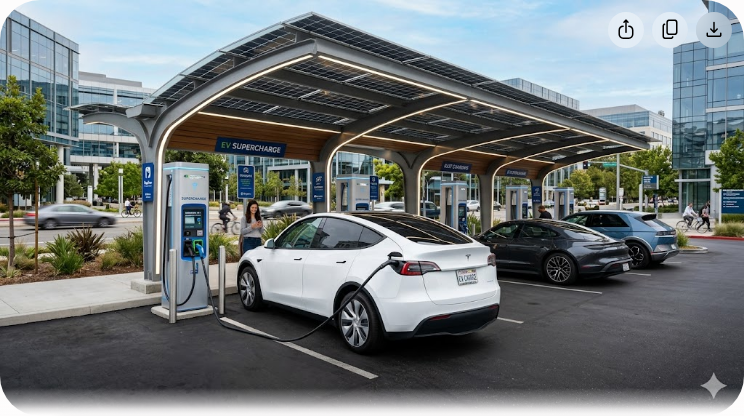
- DC fast charging: DC fast charger station performs AC→DC conversion at the station, sends DC directly to the battery. Fast (50-350 kW).
Every conversion point is a revenue opportunity for power semiconductor companies. Malaysia's new MITI policy on EV imports is making the Malaysian EV ecosystem more mature.
US companies involved:
- Tesla Inc (TSLA) - not just EVs, but also inverter technology, Megapack (BESS), and Superchargers
- NVIDIA (NVDA) - GPUs for autonomous driving + power semiconductors for EV computing
- ON Semiconductor (ON) - SiC chips for EV inverters (large Tesla, BMW customer)
- Wolfspeed (WOLF) - silicon carbide wafer maker (Tesla Cybertruck uses SiC inverters)
- Enphase Energy (ENPH), SolarEdge (SEDG) - microinverters for residential solar
Application #4: Data Centers and AI - DC Makes a Comeback
This may be the biggest change in 21st-century energy.
Traditional data center setup: - Grid AC (240V or 415V 3-phase) → UPS (AC) → Power distribution unit → Server power supply → DC (12V/48V) → Chipset
Every conversion has losses. Traditionally, total efficiency is 80-85%. For a large data center (~100MW), this loss translates to millions of ringgit per year.
New setup (HVDC data center): - Grid AC → Single conversion to 380V DC → Distribute DC directly to servers - Total efficiency: 92-95% - Savings: 30-40% capex on power equipment, 10-15% opex
NVIDIA with H100/H200/B100 GPUs uses extraordinary power - one DGX rack can consume 50-100kW. At this scale, every percentage point of efficiency improvement means millions of dollars. That's why Microsoft, Google, and Meta are building new-generation data centers with direct DC distribution.
Data center power investment opportunities: - US: Eaton, Vertiv (UPS and power), Schneider Electric - Malaysia: Kelington Group (clean rooms + power infrastructure for semicon), MMHE (engineering), cable companies like Sarawak Cable
Application #5: BESS - DC Storage for AC Grid
The BESS that TNB just launched at Santong is a perfect example of DC-AC integration at utility scale:
- Battery modules: Lithium-ion, DC 1000-1500V
- Power Conversion System (PCS): A large inverter that converts DC to AC for export to the grid
- Grid-forming capability: Sophisticated PCS can "create" a voltage reference - meaning BESS can help start the grid after a blackout
Global BESS players include: - Tesla Energy - Megapack (3.9 MWh per unit) - Fluence - Siemens-AES JV, leading independent - CATL - world's largest battery manufacturer - LG Energy Solution - second largest
For Malaysia, Tenaga is the dominant player in BESS as the grid operator.
Investment Ecosystem: Comprehensive Company List
For a summary, here's a complete map of the AC-DC ecosystem:
Bursa Malaysia (solar/RE stocks): - Solarvest, Samaiden, Pekat, JS Solar, Northern Solar - solar EPC - Tenaga Nasional - grid + BESS operator - Yinson Holdings - international offshore + RE - Sunway, Gamuda (contractors for EV charging infrastructure)
Bursa Malaysia (EV/Auto stocks): - Tan Chong Motor, EP Manufacturing - Proton assembly + EV - Industronics, Cyl Holdings - electronic components
US Market (power semiconductors + EV): - Tesla (TSLA) - EV + Megapack BESS - NVIDIA (NVDA) - GPUs + DGX power chips - ON Semiconductor (ON), Wolfspeed (WOLF) - SiC chips - Enphase (ENPH), SolarEdge (SEDG) - solar microinverters - Fluence (FLNC) - independent BESS
To build a portfolio exposure that includes both these markets, you need a trading account that supports Bursa Malaysia AND US stocks. The thematic investing strategy is organised in Stock Portfolio by Age.
FAQ
1. Can I use AC on a DC device or vice versa?
No. Giving AC to a device designed for DC (or vice versa) will damage the device. That's why every power adapter has an internal rectifier to convert AC from the socket to DC for your device. Phones, laptops, TVs - all need this conversion.
2. Why do solar panels produce DC instead of AC?
Because the photoelectric effect naturally produces electrons that flow in one direction from n-type to p-type semiconductor. To produce AC, solar panels would need additional devices (inverters) - so it's more efficient to produce DC originally and convert to AC when needed.
3. Is DC or AC more efficient?
Depends on context. AC is more efficient for long-distance transmission because voltage can be raised with transformers. DC is more efficient for storage, electronics, and whenever transmission isn't needed. That's why grids use AC but data centers are shifting to DC.
4. Will Malaysia switch to a DC grid?
Not in the short term. The AC grid is well-established and capex to switch to DC would be astronomical. But behind the inverters and storage, more DC will enter the grid. For example, BESS installed in residential areas will convert AC grid to DC storage and back to AC for home appliances.
5. Which inverter is most efficient for home solar?
Top international brands: Enphase (microinverter), SolarEdge (DC optimizer + central inverter), Sungrow, Fronius, SMA. Top efficiency is ~97-98%. For Malaysia, EPC companies like Solarvest usually choose based on warranty, price, and local support.
6. How many DC fast chargers are in Malaysia?
As of 2026, JPJ records ~1,500 DC fast charging stations in Malaysia (Q1 2026 data). Most are installed by companies like GLB Tech, JomCharge, Yinson GreenTech (subsidiary of Yinson Holdings). This expansion correlates with EV growth.
7. Is SiC chip production important for investors?
Very important. SiC (silicon carbide) chips are more efficient than regular silicon for high-voltage power applications. Tesla Model 3 was the first EV to use SiC inverters, and this trend is spreading to other EVs. Companies like Wolfspeed, ON Semi, and Infineon are the main beneficiaries.
8. How can I invest in this AC-DC theme?
Three approaches: (1) Invest directly in Malaysian solar stocks or utilities like Tenaga, (2) Buy thematic ETFs like CARZ (auto), LIT (lithium), or (3) Open an account that allows US stock trading for access to NVIDIA, Tesla, and power semicon players. For a broader diversification strategy, read The Big Capital Investing Myth.
Conclusion
The difference between AC and DC isn't just technical trivia - it's the foundation that determines the structure of the modern energy industry. From solar panels producing DC, to the AC grid connecting the country, to EV batteries storing DC, to power semiconductor chips that are the heart of every conversion - every point in this ecosystem offers long-term investment opportunities.
For investors wanting to take a position in the global energy transition theme, understanding AC vs DC gives you a mental framework for evaluating which companies will win in this ecosystem.
To start investing in energy transition stocks on Bursa Malaysia (Tenaga, Solarvest, Yinson) and also US power semiconductor players (NVIDIA, Tesla, Wolfspeed), open a CDS account with us - an account that lets you invest in Bursa Malaysia as well as overseas markets like the US and Hong Kong.
For the fundamentals of selecting energy infrastructure and technology stocks, download our Free Stock Investing Basics Ebook.
Further Reading
- What Is BESS? TNB Just Launched Malaysia's First 100MW 'Energy Bank' in Terengganu
- The End of Cheap EV Imports: Malaysia's New MITI Policy from 1 July 2026 & Its Implications
- Tenaga Nasional Berhad (TNB) Stock Analysis - In-Depth Research
- Solarvest Holdings Stock Analysis - In-Depth Research
- Stock Portfolio By Age: How to Structure Investments in Your 20s, 30s & 40s on Bursa Malaysia