Uber Technologies, Inc. (UBER)
UBER Chart
1D • NYSE
19 Jul, 11:42 pm
188.3 KB
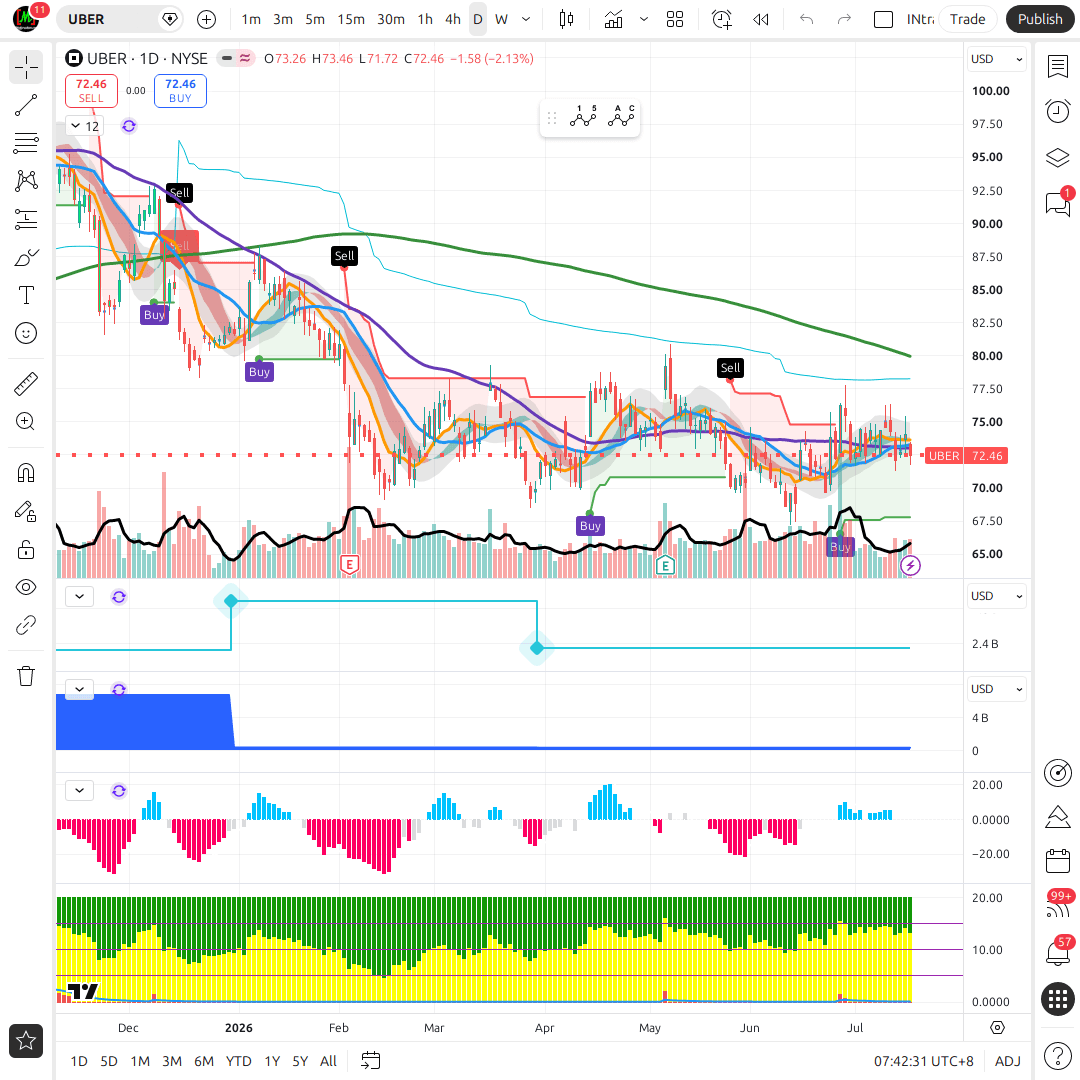
Company Profile: Uber Technologies (UBER) — From Ride-Hailing App to Robotaxi Platform
Uber Is No Longer Just a Ride-Hailing App
Most people still think of Uber as 'the taxi app'. But looking at Uber's strategy through 2025-2026, the real story now is a transformation into an autonomous vehicle (AV/robotaxi) aggregation platform. CEO Dara Khosrowshahi himself describes the AV opportunity as a 'trillion-dollar' total addressable market and says Uber will 'invest aggressively' in it — but through a very different approach than Tesla or Waymo.
Uber does NOT build or own self-driving cars. Instead, it acts as the 'middleman app' connecting nearly every major AV developer — except Tesla — onto a single booking platform. That list includes Waymo (Alphabet), Stellantis + Wayve, May Mobility, Cruise, Rivian, Pony.ai, Avride, Baidu, and most recently Lucid + Nuro, all under the new 'Uber Autonomous Solutions' initiative.
Three Business Segments (Q1 2026)
| Segment | Revenue (Q1 2026) | YoY Growth | Status |
|---|---|---|---|
| Mobility (ride-hailing) | $6.8 billion | +5% (gross bookings +20%) | Record margins |
| Delivery (food/goods delivery) | $5.07 billion | +34% | Fastest-growing segment |
| Freight (logistics) | $1.27-1.3 billion | +6% | Near-breakeven (operating loss just -$30 million) |
Big News: Uber Is Buying Delivery Hero ($14.8 Billion Deal)
On July 16, 2026 — just two days before this report was prepared — Uber announced an offer to acquire Delivery Hero (the German food delivery giant behind brands like talabat, PedidosYa, HungerStation, and Baedal Minjok) for an equity value of $14.8 billion (~$13.7 billion adjusted for Uber's existing stake). The deal would nearly double Uber's global delivery footprint from 79 to 99 markets, making it the largest delivery platform outside China. Closing is expected in the second half of 2027, pending international regulatory approvals.
New Growth Engines: Uber One & Advertising
- Uber One (subscription program): has topped 50 million members (up +50% YoY), and now accounts for MORE THAN 50% of Uber's total gross bookings. Uber One members reportedly spend roughly 3x more than non-members.
- Advertising business: has surpassed a $2 billion annualized run-rate (up +50% YoY), exceeding the company's own earlier expectation of a 2% gross-bookings penetration ceiling. Margins here are significantly higher since the business requires no drivers or extra logistics infrastructure.
Leadership
Dara Khosrowshahi has led Uber since 2017, steering the company out of the controversy-plagued Travis Kalanick era, through its 2019 IPO, and eventually to consistent GAAP operating profit since 2023. His current playbook: AV aggregation rather than owning fleets, delivery growth via large-scale M&A, and returning a substantial share of cash flow to shareholders through buybacks.
Shariah Compliance Status
Per the Zoya reference database (zoya_us_stock_reference), UBER is classified as SHARIAH COMPLIANT. Uber's core businesses — ride-hailing and delivery services — are permissible activities under Shariah screening. However, Shariah screening isn't just about the nature of the business; it also involves financial ratios such as interest-bearing debt relative to market cap, and interest income earned on cash reserves. Details on these ratios are covered in the Gold section below.
⚠️ This content is for educational purposes only and is not a specific buy/sell recommendation. Always do your own research (DYOR) before making any investment decision.
Exclusive Gold Members Content
Get in-depth analysis, target prices, and investment recommendations with Gold Members subscription.
How to Get Gold AccessCANSLIM Analysis
Exclusive Gold Members Content
Get in-depth analysis, target prices, and investment recommendations with Gold Members subscription.
How to Get Gold AccessFinancial Analysis
This section is being refreshed with the latest figures. Please check back soon.
Dividends
This section is being refreshed with the latest figures. Please check back soon.
Valuation: Uber Technologies (UBER)
Exclusive Gold Members Content
Get in-depth analysis, target prices, and investment recommendations with Gold Members subscription.
How to Get Gold AccessPeer Comparison: UBER vs LYFT vs DASH
Exclusive Gold Members Content
Get in-depth analysis, target prices, and investment recommendations with Gold Members subscription.
How to Get Gold AccessRed Flags: Risks Worth Weighing
Exclusive Gold Members Content
Get in-depth analysis, target prices, and investment recommendations with Gold Members subscription.
How to Get Gold AccessUBER Scorecard
Exclusive Gold Members Content
Get in-depth analysis, target prices, and investment recommendations with Gold Members subscription.
How to Get Gold AccessCatalysts: What Could Move UBER's Price
Exclusive Gold Members Content
Get in-depth analysis, target prices, and investment recommendations with Gold Members subscription.
How to Get Gold AccessConclusion: Ride-Hailing Cash Cow, or AV Platform of the Future?
Exclusive Gold Members Content
Get in-depth analysis, target prices, and investment recommendations with Gold Members subscription.
How to Get Gold Access