FedEx Corp (FDX)
FDX Chart
1D • NYSE
26 Sept, 12:55 am
111.4 KB
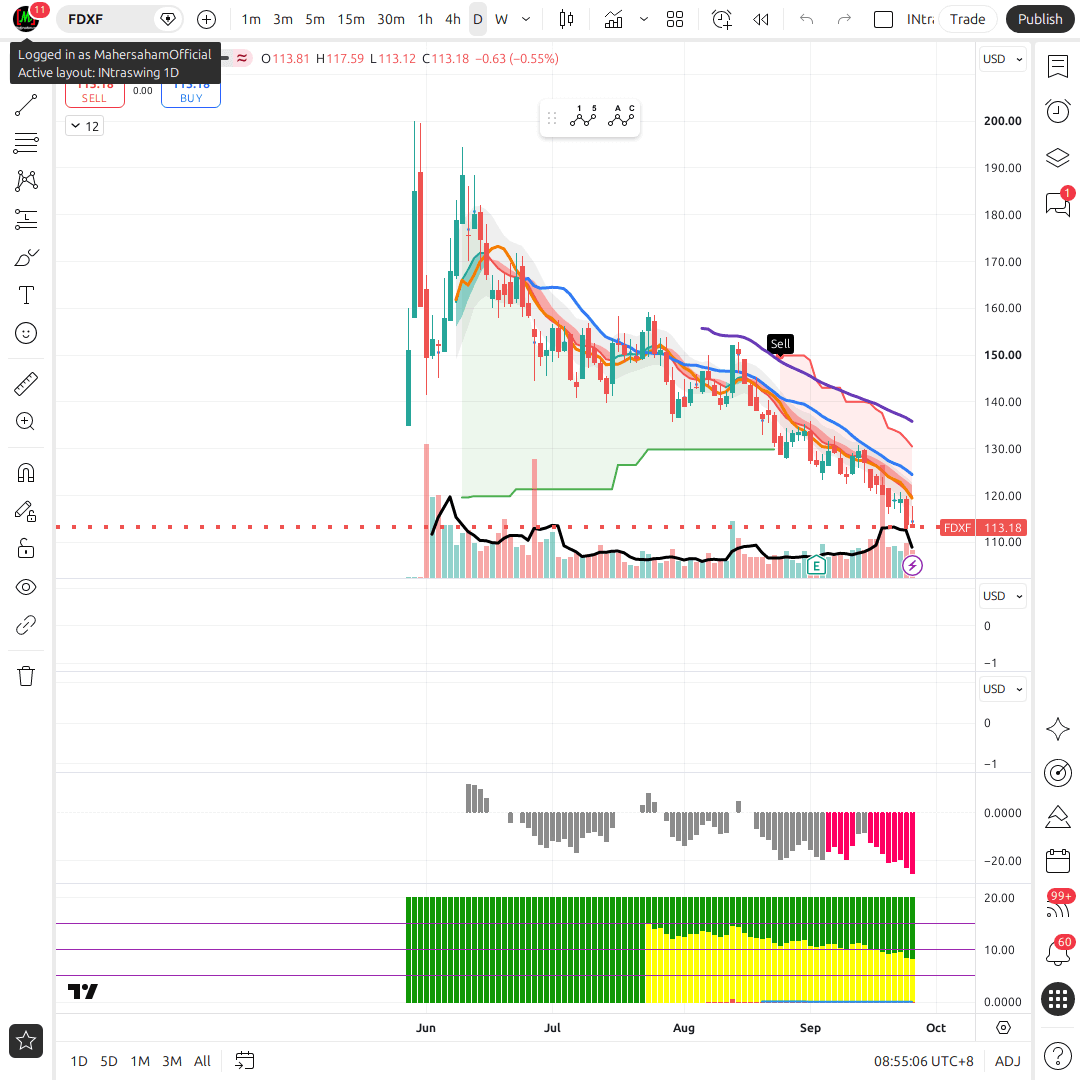
Company Profile: FedEx Corp (FDX)
The FedEx you're looking at today is not the same company it was a year ago. Across mid-2026, FedEx executed two major moves that reshaped its entire business — and you need to understand both before any financial number makes sense.
First, on June 1, 2026, FedEx completed the spin-off of its less-than-truckload (LTL) freight business, FedEx Freight, as an independent, separately-listed company on the NYSE under a new ticker — FDXF. FDX shareholders received 1 FDXF share for every 2 FDX shares held. FedEx Freight generated roughly $9 billion in annual revenue (versus ~$90 billion for FedEx overall) — small in size, but it was a historically profitable segment that no longer appears in FDX's financials going forward.
Second, in July 2026, FedEx announced the sale of its FedEx Supply Chain unit (contract logistics/3PL business, ~10,000 employees, ~150 warehouses) to CMA CGM Group (via its CEVA Logistics subsidiary) at an enterprise value of $1.4 billion — notably, the same price FedEx paid to acquire this business back in 2015 (then known as GENCO). Once the deal closes, CMA CGM becomes a preferred ocean-freight strategic partner for FedEx — so this isn't just an exit, it's a trade of an owned asset for a long-term strategic partnership.
The narrative is clear: under CEO Raj (Rajesh) Subramaniam, FedEx is deliberately simplifying its portfolio — shedding non-core businesses (LTL freight and contract logistics) to focus purely on its core parcel/express delivery operation. Post both deals, the «new» FDX consists of the Federal Express segment — a combination of International Priority (express international shipping), U.S. Domestic Priority, and U.S. Ground — now all operating under a single integrated network called Network 2.0.
By revenue mix, U.S. Ground is the largest single contributor (~$37 billion annually), followed by U.S. Domestic Priority (~$11.6 billion) and International Priority (~$9.6 billion). The overall Federal Express segment is around $35 billion, down slightly from ~$37 billion the prior year — largely a function of segment-reporting restructuring following the Ground+Express integration, not an actual demand decline.
Shariah Compliance Status: NON_COMPLIANT. Per the Zoya reference database (zoya_us_stock_reference), FDX is classified as non-Shariah-compliant. The most common reason asset-heavy logistics companies like FedEx fail Shariah screens is interest-bearing debt levels relative to market cap — and FedEx does carry substantial long-term debt (though it's being actively reduced via the 2026 tender offer, see the Financials section). Shariah-conscious investors should not include FDX in a Shariah-compliant portfolio, regardless of how compelling the business narrative or valuation may look.
Exclusive Gold Members Content
Get in-depth analysis, target prices, and investment recommendations with Gold Members subscription.
How to Get Gold AccessCANSLIM Analysis
Exclusive Gold Members Content
Get in-depth analysis, target prices, and investment recommendations with Gold Members subscription.
How to Get Gold AccessFinancial Analysis
This section is being refreshed with the latest figures. Please check back soon.
Dividends
This section is being refreshed with the latest figures. Please check back soon.
Valuation: FedEx Corp (FDX)
Exclusive Gold Members Content
Get in-depth analysis, target prices, and investment recommendations with Gold Members subscription.
How to Get Gold AccessFedEx vs Peers: UPS, XPO, ODFL & CHRW
Exclusive Gold Members Content
Get in-depth analysis, target prices, and investment recommendations with Gold Members subscription.
How to Get Gold AccessRed Flags & Key Risks
Exclusive Gold Members Content
Get in-depth analysis, target prices, and investment recommendations with Gold Members subscription.
How to Get Gold AccessMahersaham Scorecard
Exclusive Gold Members Content
Get in-depth analysis, target prices, and investment recommendations with Gold Members subscription.
How to Get Gold AccessCatalysts & Re-rating Conditions
Exclusive Gold Members Content
Get in-depth analysis, target prices, and investment recommendations with Gold Members subscription.
How to Get Gold AccessConclusion: Re-rating Story or Value Trap?
Exclusive Gold Members Content
Get in-depth analysis, target prices, and investment recommendations with Gold Members subscription.
How to Get Gold AccessRelated Stocks
Other stocks in the Air Freight & Logistics sector