The Trade Desk, Inc. (TTD)
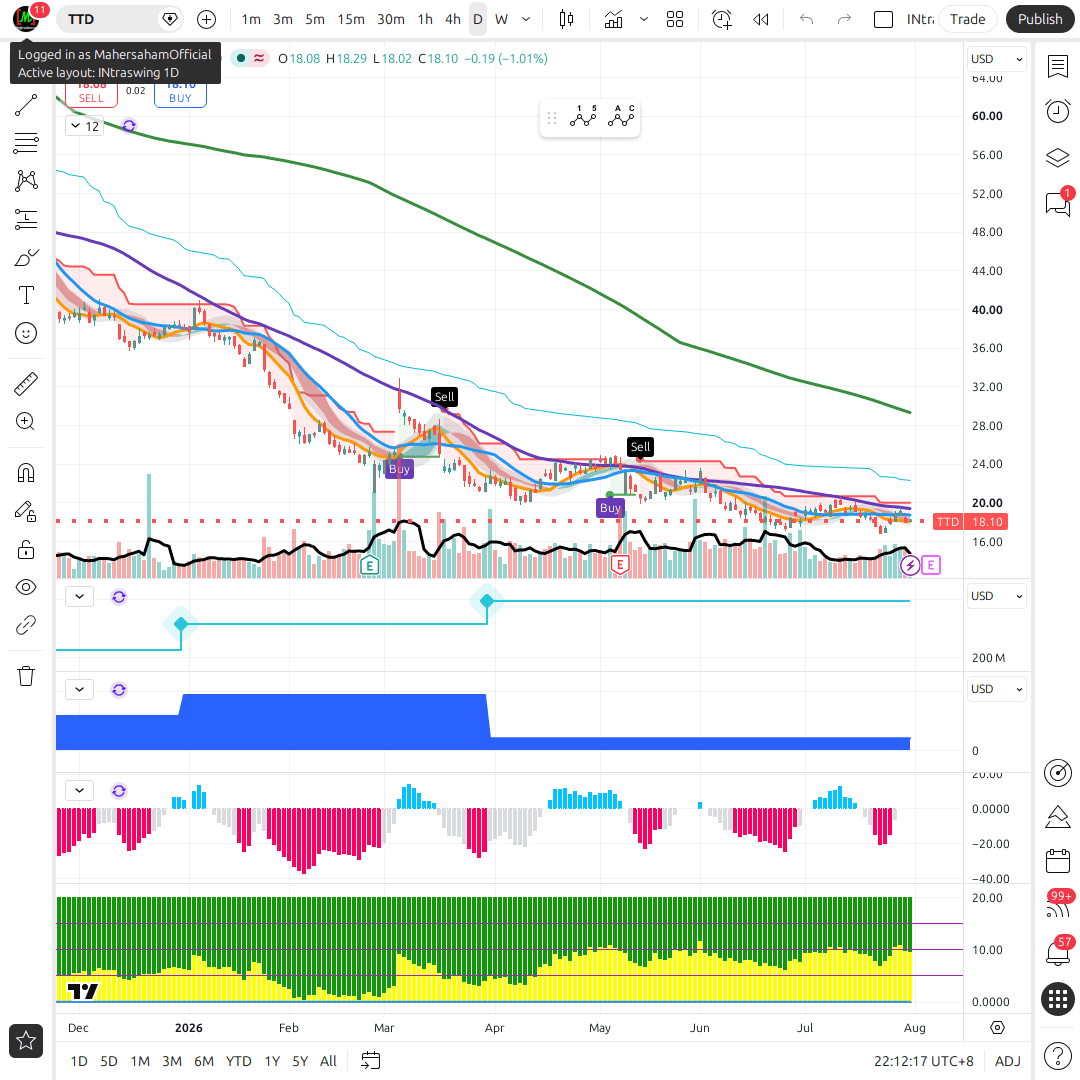
TTD Chart
1D • NASDAQ
31 Jul, 02:12 pm
167.1 KB
Company Profile: The Trade Desk (TTD)
The Trade Desk (TTD) is an independent, cloud-based demand-side platform (DSP) — it helps advertising agencies and brands buy digital ad inventory (CTV/streaming, video, display, audio, native) programmatically across the open internet. Crucially, TTD does not own a proprietary data 'walled garden' the way Google, Amazon or Meta do — its business model is to act as a neutral platform that buys ad inventory from many sources on behalf of clients. This 'open internet' positioning is the core of the bull thesis, but it is also the source of its structural competitive disadvantage against walled-garden giants sitting on first-party data.
Sector: Communication Services | Industry: Advertising / Ad-Tech DSP | Exchange: NASDAQ
The current narrative: a company in crisis, with the CEO putting $150M behind it
As of this report (23 July 2026), TTD is not just 'another ad-tech company' — it is one of the most dramatic mega-cap collapse stories of 2026. The stock has fallen roughly 84% from its all-time high (the $91-$141 range at its peak) to $17.58 as of 22 July 2026 — close to its 52-week low of $16.98. Market cap has collapsed from over $50B at the peak to roughly $8.6B. This was previously a premium-valued (40x-80x earnings) 'best-in-class ad-tech compounder' — it now trades at a fraction of that multiple.
Several factors drove the decline:
- Growth deceleration — annual revenue growth that used to run reliably above 20% has slowed to roughly 8-12%. Weaker-than-expected Q2 2026 guidance was the main trigger for the heavy May 2026 sell-off.
- CFO instability (a governance red flag) — TTD churned through THREE CFOs in about a year: long-time, trusted CFO Laura Schenkein departed, her successor Alex Kayyal left after only a few months with no clear public explanation, interim CFO (and Chief Accounting Officer) Tahnil Davis stabilized the seat, and the new permanent CFO, Nate Olmstead, was appointed 1 June 2026 and started 9 July 2026 — just two weeks before this report was written.
- The Publicis Groupe dispute — in March 2026, major ad holding company Publicis pulled TTD from its recommended DSP list after an internal audit alleged TTD was 'stacking' its ad-tech fee on top of other charges in a way not supported by contract. The dispute was resolved on 12 June 2026 via a joint statement, but neither side disclosed the settlement terms.
- Competitive pressure — Amazon has aggressively discounted its own DSP fees (reportedly as low as 1% for major spenders) to poach agency budgets from TTD, while Google's DV360 (a walled-garden platform) also competes hard.
The bull-side counter-signal: CEO insider buying
Founder and CEO Jeff Green personally bought roughly 6.4 million shares (~$150M) in early March 2026 — his largest personal purchase to date, made after the stock had already fallen more than 80% from its highs. It ranks among the largest insider buys by a Nasdaq mega-cap founder-CEO in recent memory, and it sparked an immediate rally and renewed debate over whether TTD is oversold.
Shariah status
TTD is classified as Shariah-compliant per Zoya screening in our database. For investors who screen for Shariah compliance, TTD remains a valid candidate on that basis — though the non-Shariah financial and business risks outlined above still need to be assessed separately.
In short: this is a 'crisis vs conviction' story — a business that still generates real cash, but has just come through a period of governance instability and a public dispute with a major partner, while its founder-CEO has put substantial personal capital behind a bet that the market has overreacted.
Exclusive Gold Members Content
Get in-depth analysis, target prices, and investment recommendations with Gold Members subscription.
How to Get Gold AccessCANSLIM Analysis
Exclusive Gold Members Content
Get in-depth analysis, target prices, and investment recommendations with Gold Members subscription.
How to Get Gold AccessFinancial Analysis
TTD's quarterly revenue trend through 2026 shows a clear deceleration pattern: Q1 2026 $689M (+12% YoY) → Q2 2026 $715M (+3% YoY, below the roughly $750M initial guide) → Q3 2026 guidance of roughly $650M (-12% YoY, the first revenue decline guided in company history). Q2 adjusted EBITDA held up at $241M (34% margin), but Q3 guidance calls for adjusted EBITDA to fall sharply to roughly $160M — implying a margin of roughly 24.6% if revenue lands at $650M, a meaningful margin compression.
Q2 2026 GAAP net income fell 29% YoY to $64M (EPS $0.14 vs $0.18); non-GAAP EPS of $0.34 missed the $0.37 analyst estimate. On the brighter side: Joint Business Plans (JBPs) — strategic contracts with large clients — grew at 6x the overall revenue growth rate, with 217 JBPs signed (+38% YoY), and client retention held above 95% for an 11th straight year.
The Restructuring Charge
The 15% global workforce reduction (~575 jobs) announced September 3, 2026 is expected to cost $39-51M in cash (severance/employee benefits), partially offset by a $4-5M stock-based comp reversal. This will land mainly as a one-off item in Q3 2026, with the reduction expected to be “substantially complete” by the end of that quarter.
Genuine Efficiency Move, or a Symptom of Slowing Growth?
Honestly — both. Management frames the cut as a strategic reorganization (“pods/scrums”) to focus resources on higher-priority areas, not a sign of financial distress. But the fact that it happened IMMEDIATELY after the company's first-ever negative revenue guide suggests a reactive element too — not purely proactive. The key thing for investors to watch: does margin improve consistently once these charges roll off (a sign the efficiency move worked), or does revenue keep sliding even after costs are cut (a sign of a deeper structural problem)?
Exclusive Gold Members Content
Get in-depth analysis, target prices, and investment recommendations with Gold Members subscription.
How to Get Gold AccessDividends
The Trade Desk pays no dividend, and this is not new — the company has never declared one as a public company. This is typical of a growth-stage tech/ad-tech company that chooses to keep cash for reinvestment in product (e.g. Kokai/Kokai Zuma), sales & marketing, and share buybacks as its preferred form of capital return over cash dividends.
With $39-51M in restructuring costs landing from the 2026 reorganization, and margin pressure expected in Q3 2026, the company's current priority is clearly disciplining operating costs rather than introducing any new form of cash return to shareholders.
Exclusive Gold Members Content
Get in-depth analysis, target prices, and investment recommendations with Gold Members subscription.
How to Get Gold AccessValuation: TTD
Exclusive Gold Members Content
Get in-depth analysis, target prices, and investment recommendations with Gold Members subscription.
How to Get Gold AccessPeer Comparison
Exclusive Gold Members Content
Get in-depth analysis, target prices, and investment recommendations with Gold Members subscription.
How to Get Gold AccessRed Flags
Exclusive Gold Members Content
Get in-depth analysis, target prices, and investment recommendations with Gold Members subscription.
How to Get Gold AccessScorecard
Exclusive Gold Members Content
Get in-depth analysis, target prices, and investment recommendations with Gold Members subscription.
How to Get Gold AccessCatalysts
Exclusive Gold Members Content
Get in-depth analysis, target prices, and investment recommendations with Gold Members subscription.
How to Get Gold AccessConclusion
Exclusive Gold Members Content
Get in-depth analysis, target prices, and investment recommendations with Gold Members subscription.
How to Get Gold AccessRelated Stocks
Other stocks in the Communication Services sector