Lose 50% and You Need 100% Gain to Break Even - The Math Every Investor Must Know

Most new investors focus on how much profit they can make. But experienced investors know something far more important - preserving capital. Why? Because the math of investment losses is brutally unfair. The bigger your loss, the harder it becomes to recover.
In this article, we will break down the real mathematics behind investment losses and why legendary investors like Warren Buffett live by the principle "Rule No. 1: Never lose money."
What Is Capital Preservation?
Capital preservation means protecting your original investment from suffering large losses. It does not mean you will never lose money - that is impossible in investing. But it means you need to control your losses so they remain small and recoverable.
This concept is the foundation of proper risk management. A smart investor is not one who always makes profits - but one who knows how to limit their losses.
Why Preserving Capital Matters More Than Chasing Profits
There is one clear mathematical reason why protecting capital is more important than chasing gains - the asymmetry of losses.
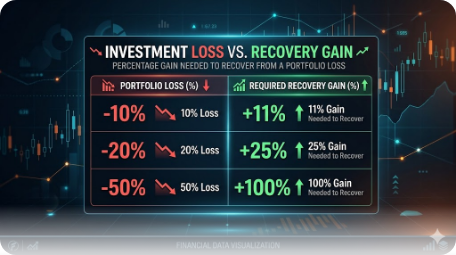
When you lose a certain percentage, you need a larger percentage gain to get back to where you started. This relationship is not linear - it is exponential.
Simple example:
- If you have RM10,000 and lose 50%, your capital drops to RM5,000
- To get back to RM10,000 from RM5,000, you need a 100% gain - that is, you need to double your money!
This means losses are always more powerful than gains. One large loss can wipe out years of profits.
The Math Table: How Much Gain Do You Need to Recover?
Here is the complete table that every investor should memorize. It shows how much percentage gain you need to break even after suffering a loss:
| Loss (%) | Remaining Capital (from RM10,000) | Gain Needed to Break Even (%) |
|---|---|---|
| 5% | RM9,500 | 5.3% |
| 10% | RM9,000 | 11.1% |
| 15% | RM8,500 | 17.6% |
| 20% | RM8,000 | 25.0% |
| 25% | RM7,500 | 33.3% |
| 30% | RM7,000 | 42.9% |
| 40% | RM6,000 | 66.7% |
| 50% | RM5,000 | 100.0% |
| 60% | RM4,000 | 150.0% |
| 70% | RM3,000 | 233.3% |
| 80% | RM2,000 | 400.0% |
| 90% | RM1,000 | 900.0% |
Formula: Gain needed = Loss / (1 - Loss)
Example: 30% loss → 0.30 / (1 - 0.30) = 0.30 / 0.70 = 42.9%
Notice the frightening pattern - once losses exceed 50%, recovery becomes nearly impossible for most ordinary investors.
Real Scenarios on Bursa Malaysia
To make this clearer, let us look at real scenarios that happen to investors on Bursa Malaysia:
Scenario 1: The investor who cut losses early
Ahmad buys stock XYZ at RM2.00 for 5,000 units (capital: RM10,000). The price drops to RM1.80 - a 10% loss. Ahmad cuts his loss and accepts the RM1,000 loss.
- Remaining capital: RM9,000
- Gain needed to recover: 11.1% (RM1,000)
- Reasonable time to recover: a few weeks to months
Scenario 2: The investor who "hoped the price would come back"
Siti buys the same stock. The price drops to RM1.80, RM1.50, RM1.00. Siti does not cut her loss because she "hopes the price will come back." Eventually, the stock falls to RM0.50 - a 75% loss.
- Remaining capital: RM2,500
- Gain needed to recover: 300% (RM7,500)
- Reality: Extremely difficult and could take years, if at all possible
The Lesson
Ahmad lost a small amount but can recover quickly. Siti lost big and needs a miracle to break even. This is why cutting losses early is a form of capital preservation.
Why Our Brain Hates Cutting Losses
According to behavioral finance research, humans naturally experience what is called loss aversion - the pain from a loss is felt 2x more intensely than the joy from an equivalent gain.
This causes investors to:
- Refuse to sell losing stocks - because selling means "admitting a mistake"
- Let losses grow bigger - hoping the price will recover (denial)
- Sell winning stocks too early - fearing the profits will disappear
The result? Average investors tend to hold losing stocks too long and sell winning stocks too early - the exact opposite of what they should do.
5 Capital Preservation Strategies for Investors
1. Set a Cut Loss Limit (Stop Loss)
Before buying any stock, decide how much loss you can tolerate. Most professional investors use a threshold between 5% to 15% depending on their strategy.
Example: If your cut loss limit is 10%, and you buy a stock at RM2.00 - you will sell if the price drops to RM1.80. No compromises.
2. Position Sizing - Never Go "All In"
Never put all your capital into a single stock. Spread your investments so that if one stock falls, it does not significantly damage your overall portfolio.
Basic rule: Never allocate more than 10-15% of your portfolio in a single counter.
3. Diversify Across Sectors
If all your stocks are in the same sector (e.g., all technology stocks), a single sector downturn can cause all your stocks to fall simultaneously. Diversifying across different sectors reduces this risk.
4. Use Trailing Stops
A trailing stop is a technique where you raise your stop loss level as the stock price rises. Example: if a stock rises from RM2.00 to RM2.50, raise your stop loss from RM1.80 to RM2.25. This protects your profits while giving room for further price increases.
5. Cash Is a Position
Many investors feel they must always be "fully invested." This is wrong. Holding cash during uncertain markets is a valid strategy. According to the Securities Commission Malaysia, investors are advised to always have an emergency fund before investing.
Cash protects your capital and gives you the opportunity to buy at lower prices when the market truly crashes.
Compounding: Why a Larger Capital Base Gives You an Edge
Another reason capital preservation matters - compounding.
Say two investors each start with RM100,000 and average 10% annual returns:
Investor A (preserves capital - no major losses):
- Year 1: RM110,000
- Year 5: RM161,051
- Year 10: RM259,374
Investor B (suffers 50% loss in year 3, recovers at 15% per year after):
- Year 1: RM110,000
- Year 2: RM121,000
- Year 3: RM60,500 (50% loss)
- Year 5: RM80,003
- Year 10: RM160,909
After 10 years, Investor A has RM259,374 while Investor B only has RM160,909 - a difference of nearly RM100,000! One major loss in year 3 destroyed Investor B's entire portfolio trajectory.
Warren Buffett and the Principle of Capital Preservation
Warren Buffett, the world's most successful investor, is famous for his two rules:
"Rule No. 1: Never lose money. Rule No. 2: Never forget Rule No. 1."
This does not mean Buffett has never lost money - he has lost billions of dollars. But his principle is clear: prioritize protecting capital before chasing profits.
Other famous investors who share this approach include Ray Dalio (founder of Bridgewater Associates, the world's largest hedge fund) who emphasizes the importance of diversification and risk management as the foundation of investing.
Charlie Munger (Buffett's partner) also said: "The first rule of compounding: Never interrupt it unnecessarily." Every major loss is an interruption to the compounding process.
When Capital Preservation Becomes Critical
Capital preservation becomes even more important in these situations:
- You are nearing retirement - time to recover from losses is shrinking
- Markets are bearish - better to hold cash than to "catch a falling knife"
- You are just starting to invest - small capital needs to be carefully protected
- Economic uncertainty - such as during recessions or global crises
Frequently Asked Questions (FAQ)
Does capital preservation mean I cannot take any risk at all?
No. Capital preservation means you control risk, not avoid it. You can still invest in stocks, but with clear loss limits and appropriate position sizes.
What percentage loss is considered "serious"?
Generally, losses exceeding 20% are considered significant because you need a 25% gain to recover. Most professional investors set cut loss limits between 5-15%.
Why do many new investors fail to practice cut loss?
Because of human psychology. Loss aversion makes us hope the price will come back and refuse to "admit a mistake." It takes discipline to cut losses consistently.
Is capital preservation suitable for long-term investors?
Yes. While long-term investors can "ride out" market fluctuations, large losses (50%+) still destroy compounding. Long-term investors also need to ensure their portfolios are diversified to avoid catastrophic losses.
How do I calculate how much gain I need to recover from a loss?
Use the formula: Gain Needed = Loss / (1 - Loss). Example: 30% loss → 0.30 / 0.70 = 42.9%. Or refer to the table in this article.
Does a stop loss guarantee I will not lose more than my limit?
Not necessarily. In highly volatile market conditions or during a gap down (price opens much lower than the previous close), a stop loss may not execute at the exact price. But it remains an important risk management tool.
What is the difference between cut loss and panic selling?
Cut loss is a decision planned before buying a stock - you know when to exit if the price falls to a certain level. Panic selling happens when you sell out of fear without a clear strategy, usually during sudden market drops.
Can I recover from a 90% loss?
Mathematically, you need a 900% gain to recover from a 90% loss. This is extremely difficult. That is why capital preservation is so important - it is far better to prevent large losses upfront than to try to recover later.
Conclusion
The math of losses does not favour anyone. The bigger your loss, the harder it is to recover - and this is the primary reason why capital preservation must be every investor's number one priority. Discipline in cutting losses, position sizing, and diversification are not just theories - they are tools that protect your financial future.
If you are serious about investing and want to start building your portfolio the right way, the first step is opening a CDS trading account.
Open a CDS trading account today through Mahersaham to start investing on Bursa Malaysia as well as international stocks including the US and Hong Kong markets.
Download the free Stock Market Basics Ebook to understand key investment concepts including risk management.