EPF Dividend Forecast: Could It Reach 6.3%? Here's the In-Depth Analysis You Need to Know

Every time the beginning of the year rolls around, there's one topic that's guaranteed to be "trending" from the mamak stalls to the family WhatsApp group: "How much is the EPF dividend this year?"
The anticipation this time feels slightly different. After spending the whole of 2025 navigating various economic dynamics — from the strengthening of the Ringgit to the AI sector boom — many contributors are hoping for "good news" as a remedy for the still-challenging cost of living.
Based on the Employees Provident Fund (EPF) investment performance throughout 2025, many economic analysts have begun citing some quite attractive figures: between 5.6% and 6.4%!
But how accurate are these numbers? Let's break it down one by one.
Why the 5.6% – 6.4% Figure Is Relevant
These numbers aren't pulled out of thin air — they come from quarterly performance figures announced by EPF itself for 2025, showing a very encouraging trend.
1. The Real "Hero": Foreign Equities
Although EPF's foreign assets make up only about 38% of its total portfolio, their contribution to income often exceeds 50%. Throughout 2025, global equity markets — especially in the US and Europe — continued to be driven by the AI revolution and recovery in the manufacturing sector. This gave EPF a significant advantage in generating high returns.
2. The Rise of Bursa Malaysia (Data Centre Era)
Have you noticed? Bursa Malaysia throughout 2025 looked more "energised." With the influx of foreign investment into the Data Centre and semiconductor sectors, the FBM KLCI index showed better stability. As the largest institutional investor, EPF certainly reaped the rewards from rising share prices of local blue-chip companies.
3. Account Restructuring & Cash Flow
2025 was the first full year of the Flexible Account (Account 3) implementation. Despite some withdrawals, EPF's mature Strategic Asset Allocation management successfully balanced liquidity (cash) needs without compromising long-term investment opportunities.
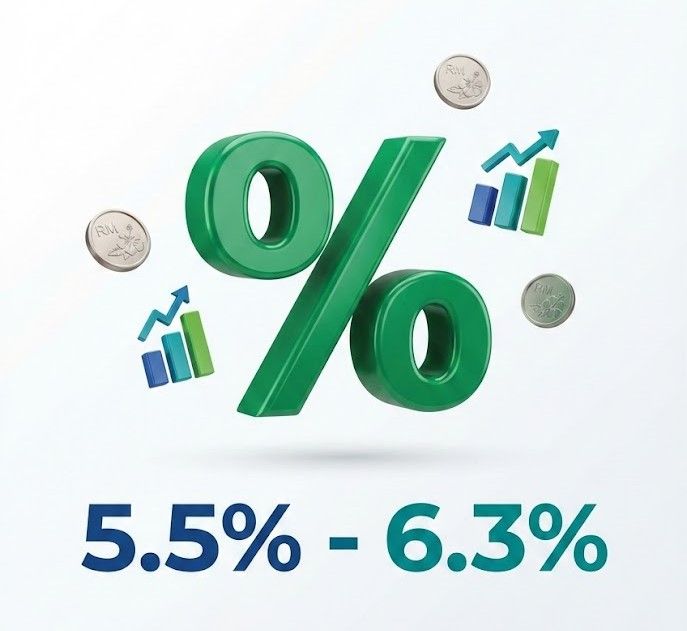
Comparison of Expectations: Conventional vs Shariah
As is customary, Conventional Savings typically yield slightly higher returns. However, the gap is narrowing as Shariah-compliant assets now encompass the booming technology sector.
| Savings Category | Expected Dividend 2025 (Announced 2026) | Analysis Notes |
|---|---|---|
| Conventional Savings | 5.6% - 6.4% | Strongly driven by global equities and domestic banking. |
| Shariah Savings | 5.3% - 5.9% | Focus on technology, telecommunications, and green energy sectors. |
Account 3 (Flexible) Challenge: Does It Drag Dividends Down?
Since its introduction in May 2024, Account 3 allows contributors to withdraw money at any time. Technically, to enable immediate withdrawals, EPF needs to hold more assets in cash or money market instruments which typically yield lower returns than equities.
However, according to 2025 performance reports, total new contributions and reinvestment still far exceed total withdrawals. Therefore, the impact of "Account 3" on dividends is expected to be very minimal.
The Power of Compounding: Why 0.1% Is So Expensive
Some might say, "Come on, the difference between 5.5% and 5.6% is tiny." Hold on! In the world of retirement investing, 0.1% is a massive difference over the long term.
For example, if you have RM100,000 in EPF:
- Dividend 5.5% = RM5,500
- Dividend 6.4% = RM6,400
- Difference per year = RM900
If you let this RM900 "compound" over 10-20 years, the amount could reach tens of thousands of ringgit!
Looking Back: EPF 10-Year Performance Record
Let's look at the dividend data (Conventional) as a comparison before we receive the official 2025 results:
| Year | Dividend Rate (%) | Economic Situation |
|---|---|---|
| 2024 | 5.50% | Year of Account 3 introduction & Bursa recovery. |
| 2023 | 5.50% | Global interest rate hikes. |
| 2022 | 5.35% | Global inflation & Ukraine war. |
| 2021 | 6.10% | Global stock market rebound. |
| 2020 | 5.20% | COVID-19 pandemic. |
| 2019 | 5.45% | US-China trade war. |
| 2018 | 6.15% | Domestic political uncertainty. |
| 2017 | 6.90% | Very strong global economic performance. |
| 2016 | 5.70% | Oil prices plummeted. |
| 2015 | 6.40% | Stable equity markets. |
How to Check Estimated Dividend Using i-Akaun (2026 Version)
The EPF i-Akaun app is now far more advanced. You can run your own simulation:
- Open the App: Log in to the latest version of i-Akaun.
- View Account Breakdown: Check the balance in your Retirement Account (1), Wellbeing Account (2), and Flexible Account (3).
- Simulation Calculator: Enter an expected figure (e.g. 6.0%) to see how much is estimated to be credited to your account.
- Manual Calculation (Simple Maths)
If you want a quicker method, you can use this simple formula to find out how much "extra" money will come in:
Dividend Amount = Average Annual Balance x Dividend Rate
Example: If your savings balance is RM50,000 and the dividend announced is 6.0%:
RM50,000 x 0.06 = RM3,000
Note: EPF's actual calculation is based on daily rest, so the amount may differ slightly if you made withdrawals or contributions were inconsistent throughout the year.
Trend Analysis: Is 6.3% Something Impossible?
If we look at the trend above, a figure of 6.0% and above is not something foreign to EPF. The last time we enjoyed a "6 series" dividend was in 2021 (6.10%).
Why does this year look brighter than before?
- No More "Special Withdrawal Schemes": In 2021 and 2022, withdrawals such as i-Sinar and i-Citra put pressure on EPF's cash liquidity. For 2024, although Account 3 exists, its impact is more controlled as it was structurally planned, not an emergency ad-hoc measure.
- Mature Diversified Portfolio: EPF is now more aggressive in Private Equity and infrastructure investments abroad, which provide higher returns compared to fixed deposits or ordinary bonds.
- Shariah Dividend Stability: If you've noticed, the gap between Conventional and Shariah is narrowing. In 2023, the difference was only 0.10% (5.50% vs 5.40%). This shows that Shariah-compliant assets are becoming increasingly competitive and are no longer considered the "stepchild" of the investment portfolio.
Comparison With Other Instruments (ASB & FD)
As savvy investors, we need to compare with the alternatives available in the Malaysian market:
- ASB (Amanah Saham Bumiputera): For the financial year ending December 2024, ASB announced a distribution of 5.25 sen per unit (4.75 sen + 0.50 sen bonus). If EPF announces 6.0%, it means EPF surpasses ASB for the second time in recent years.
- Fixed Deposit (FD): The current average FD rate is around 2.8% to 3.5%. Clearly, leaving your money in EPF provides returns nearly double that of FD.
Conclusion: Should We Be Smiling?
The answer: Yes! A dividend rate above 5.0% in today's economic conditions is actually very competitive. Compared to fixed deposits (FD) at only around 2.5% to 3.5%, EPF remains the best low-risk investment "goldmine" for Malaysians.
As contributors, what can we do?
- Check Your Nomination: Make sure your beneficiaries are named. Don't leave money hanging if anything happens.
- Voluntary Contribution: If you have extra funds, consider making voluntary self-contributions up to RM100,000 per year to maximise returns.
- Don't Be Tempted: If you don't really need it, avoid withdrawing from Account 3 just for short-term wants. Let the money "work" for your retirement.
Let's all look forward to the official announcement from EPF soon. Hopefully there's good news for all of us!
Here's another secret you need to know: Why can EPF deliver such solid dividends? The answer is because they invest in the stock market (equities).
If EPF can make money on Bursa Malaysia and Wall Street, why should we just be spectators? While waiting for the dividend to 'hit' your account, why not start learning how to generate your own profits?
Let's learn how to buy and sell stocks wisely with an experienced Remisier! The first step is to own your own CDS account. You can easily open an account here: Start Learning Stocks on Bursa Malaysia.
Download our free basic stock ebook to learn the fundamentals of stock investing from scratch.
Frequently Asked Questions (FAQ)
What is the expected EPF dividend rate for 2025?
Based on EPF's quarterly investment performance throughout 2025, analysts estimate the Conventional dividend rate to be between 5.6% and 6.4%, while the Shariah dividend is projected at 5.3% to 5.9%.
Does Account 3 (Flexible Account) affect EPF dividends?
The impact is expected to be very minimal. Although Account 3 allows anytime withdrawals, total new contributions and reinvestment still far exceed total withdrawals, so EPF's investment capacity remains largely unaffected.
How do I calculate my estimated EPF dividend?
Use the simple formula: Dividend Amount = Average Annual Balance x Dividend Rate. For example, RM50,000 x 6.0% = RM3,000. Note that EPF uses daily rest calculations, so actual amounts may vary slightly.
How does EPF dividend compare to ASB and Fixed Deposits?
EPF's expected 5.6%-6.4% significantly outperforms both ASB (5.25 sen per unit for 2024) and Fixed Deposits (averaging 2.8%-3.5%). EPF remains one of the best low-risk investment vehicles for Malaysians.