Annual Report Part 7: The Role of Committees

Assalamualaikum and greetings to everyone who has taken the time to visit the Mahersaham blog today.
Hello!!!!!
How are you doing?
Hope you are all well.
How are your fundamental analysis skills in stocks coming along?
I hope you are becoming increasingly skilled at analysing companies that you have set your heart on for investing.
Related articles you should read:
- 1. How to Read a Company Annual Report - Part 1
- 2. How to Read an Annual Report Part 2: Corporate Exercise
- 3. How to Read an Annual Report Part 3 - Corporate Structure
- 4. Annual Report Part 4: Management Discussion & Analysis
- 5. How to Read an Annual Report Part 5 - Information On Directors
- 6. How to Read an Annual Report Part 6: Corporate Governance
I will continue with how to read annual report part 7.
InshaAllah, this is the final part.
It mostly touches on the role of committees.
Without realising it, the articles on annual reports are among the longest in the Mahersaham blog.
Perhaps you can already tell that this is a sign that studying a company's annual report is extremely important.
Understanding annual reports can help you conduct fundamental analysis in the stock market.
Continue scrolling for further explanation.
Audit Committee
Is a company audit report necessary?
Yes, because the audit report serves as a check and balance within a company.
It ensures that every company continuously improves their quality.
Among the duties involved are:
- How to select or appoint internal or external auditors.
- External auditor - audits the company's accounts or financials.
- Internal auditor - reviews and ensures the company follows SOPs in every company activity.
- Review of the 3-year internal audit plan.
- Reviewing quarterly reports and providing suitable recommendations or improvements.
- Reviewing major corporate proposals and major investments taken.
- Analysis of Related-Party Transactions
- Related-party transactions are dealings between two parties that have a pre-existing business relationship.
- A simple example would be: the majority of the largest shareholders in Company ABC are those who have family ties.
- They need to remember that there is also public capital in the company, so they cannot act as they please for personal gain.
Risk Management Committee
For companies that have grown and developed, this is a necessity to implement.
The committee's duty is to assess and control risks involving the company.
Among the matters involved in the risk management committee are process and risk profile.
Within the process, this includes:
- Internal environment
- Identify the situation occurring within the company.
- Objectives
- Know the company's objectives
- Know the objectives when analysing risk management
- Event identification
- Risk assessment
- Risk response
- The company's response to existing risks
- Control activities
- Information and communication
- Inform those involved about risks so they can make correct decisions.
- Especially involving fairly significant risks.
- Need to inform top management
- Monitoring
- Continuously monitor existing risks.
- Whether risks are decreasing or increasing
Among the risk profiles that need to be analysed include:
***important note: the list below is specific to the company Pohuat as from part 1 of the annual report, I used Pohuat as an example.
- Adverse changes in the global economy or in the country in which the Group operates in and sells to;
- Intense competition in global furniture trade and increased price pressure on products;
- Depleting wood resources and increasing raw material prices;
- Shortage of labour and competition for managerial and technical skills/capabilities in manufacturing processes;
- Tightening in regulation and law in countries where the Group operates and sells to;
- Health, safety, environment and security risk;
- Exposure to foreign exchange fluctuation;
- Exposure to receivable and credit risks.
Every company faces different risks.
So when we study a company's annual report, the company will identify potential risks that they may face.
And several measures to overcome or reduce risks to the company.
S.W.O.T
Additionally, one of the important things for us to analyse a company as a whole is by understanding SWOT.
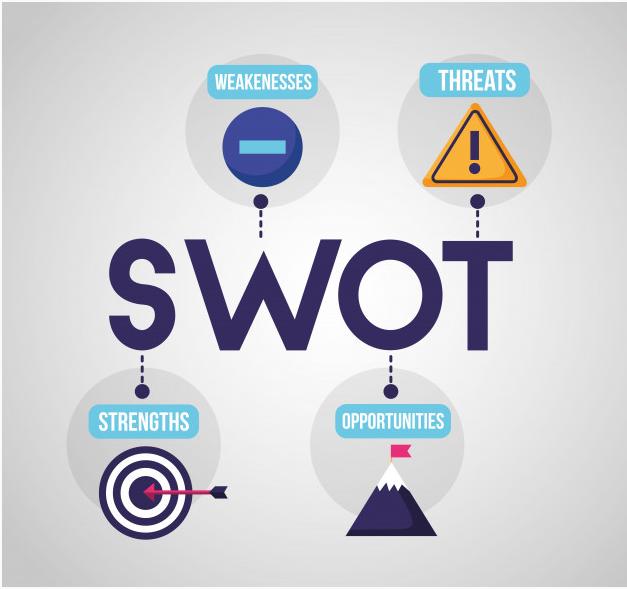
What is SWOT?
SWOT is an acronym for 4 words:
- Strengths
- Weaknesses
- Opportunities
- Threats
Strengths
- What good things is the company doing?
- What differentiates the company from its competitors?
- Who are the company's directors?
- What and how much are the assets owned by the company?
Weaknesses
- What are the company's shortcomings?
- What do competitors do better than this company?
- Does the company lack resources (raw materials/manpower/capital)?
Opportunities
Are there any opportunities to take the company to a higher level:
- Opportunities for less competition in certain areas
- Products not yet produced by any company
- Innovation that can be implemented in the company's products/services
Threats
Risks that may be faced by the company, as I explained above.
FAQ
1. What is the role of committees in a company's annual report?
Committees in annual reports are responsible for overseeing corporate governance, ensuring transparency in financial reporting, and providing strategic advice to the board of directors to protect shareholders' interests.
2. Why should investors read the committee section in an annual report?
The committee section reveals how a company is managed internally. Investors can assess whether the company's management is transparent, accountable, and has good risk controls before making investment decisions.
3. What types of committees are commonly found in annual reports?
The main committees include the Audit Committee, Nomination Committee, Remuneration Committee, and Risk Management Committee. Each has its own function in ensuring the company operates well.
4. How does SWOT analysis in an annual report help investors?
SWOT analysis helps investors understand the company's strengths, weaknesses, opportunities, and threats. This provides a comprehensive picture of growth potential and risks that may be faced before making investment decisions.
Conclusion
Investing requires not only capital but also knowledge. Without knowledge, an investor may not profit but rather face losses. By understanding annual reports and the role of committees, you can conduct more in-depth fundamental analysis.
Want to start investing with more confidence? Open a CDS account with Mahersaham today and download the free stock ebook for a comprehensive investment guide.